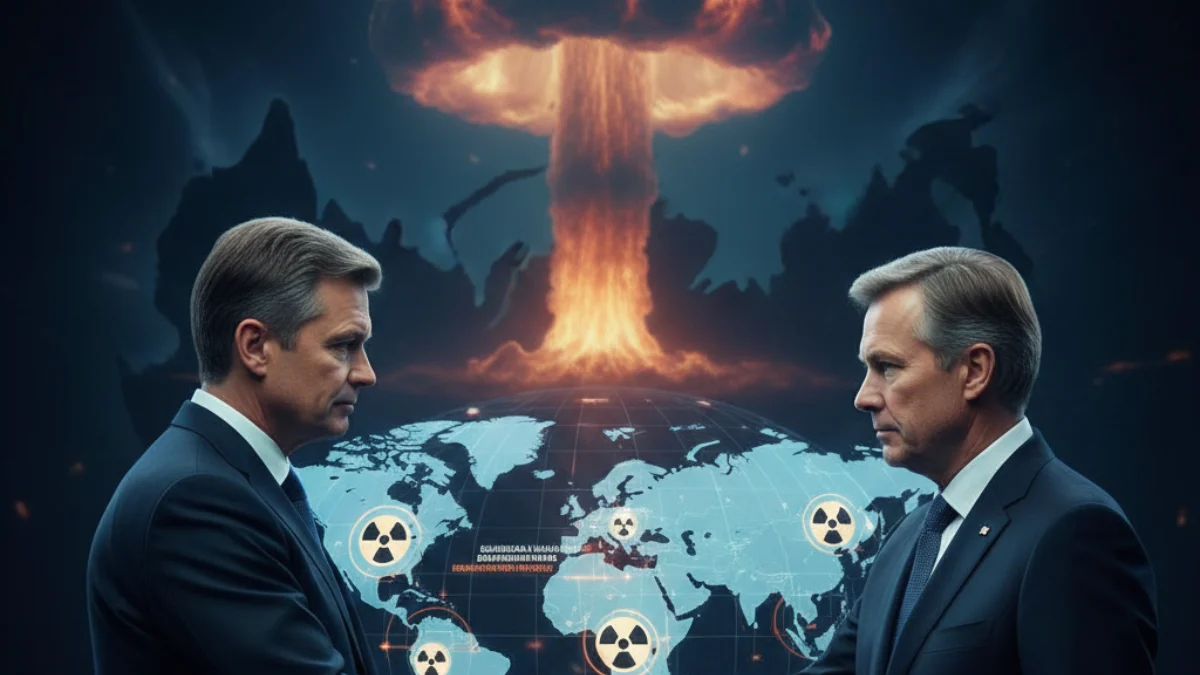
Europe is entering a new nuclear era. Sweden, a country that for decades stood as a bulwark of disarmament, has taken a step that just a few years ago would have seemed unthinkable: it has formally requested to participate in the nuclear program led by France and the United Kingdom. Prime Minister Ulf Kristersson has been clear: in a world where ‘dangerous countries’ hold the red button, European democracies cannot afford to be unprotected.
This move is the most evident sign that the geopolitical chessboard has been blown apart. Sweden’s entry into NATO in 2024 was only the beginning; now, the uncertainty about Washington’s commitment to European defense is forcing the continent’s powers to seek their own nuclear sovereignty. Stockholm not only wants to be in the debates; it wants to be part of the shield that deters a Russia that keeps displaying its nuclear muscle in the Baltic.
Sweden’s strategy also rests on a solid material basis. Last year, the country lifted the ban on uranium extraction within its territory. What began as a plan to guarantee electricity could end up becoming the fuel for the first multinational European nuclear force. Sweden no longer merely asks for protection; it is prepared to put its resources on the table to ensure that the ‘nuclear umbrella’ is, at last, exclusively European.
The End of the Taboo: Why Sweden Wants the Bomb Now?
Kristersson’s decision responds to a paradigm shift in collective security. After joining NATO, Sweden has understood that conventional deterrence might not be enough against a Russian arsenal that exceeds 5,500 warheads. The ‘nuclear peace’ that has reigned in Europe for decades is seen today as fragile, and Stockholm believes that only access to weapons of mass destruction can guarantee that the Nordic borders remain respected.
Moreover, there is a factor of political distrust toward the United States. With a U.S. administration questioning the usefulness of the Atlantic Alliance, countries like Germany, Poland and now Sweden see the Paris-London axis as a more stable guarantee. France, the only EU power with its own autonomous arsenal, has shown openness to a ‘nuclear dialogue’ with its partners, opening the door to a much more aggressive and autonomous European NATO.
Sweden’s Uranium: From Energy to Deterrence
Sweden has an advantage that other European countries do not have: its vast uranium reserves. Until recently, exploiting this mineral was prohibited for environmental and moral reasons, but the war in Ukraine and the energy crisis changed the priorities. If Sweden decides to process its own uranium for military purposes, it would go from a protected country to a key player in the production of atomic weapons.
This turn has sparked an intense internal debate in a country where pacifism is part of the national DNA. Yet the Government insists that deterrence is the only way to avoid a larger conflict. “As long as there are dangerous countries with nuclear weapons, democracies must also have them,” Kristersson says, marking a red line that places Sweden at the vanguard of the new European arms race.
The 2026 Scenario: A Europe Divided by the Atom
Stockholm’s incorporation into the Franco-British program could be the first step toward a common European nuclear force. Until now, the British arsenal depended heavily on American technology, but the new alliance signed between London and Paris seeks to create an independent alternative. If Stockholm provides funding and technology, the axis of military power in Europe would shift definitively to the north and west, leaving Russia with a much more cohesive adversary.
Sweden’s request is a warning to navigators: the postwar world order is dead. Stockholm’s pursuit of the ‘nuclear umbrella’ is not just a military move; it is a declaration of survival. Europe is determined not to be again a playground for others, even if that means embracing again the doctrine of mutual assured destruction.