A little over a week ago, the Iranian goalkeeper Rashid Mazaheri posted several photos of Ali Khamenei on Instagram. In the images, the long-time religious leader of Iran was depicted as “Satan.” Mazaheri, who had earned three international caps, wrote: “Your rule over this holy land is over.” Shortly afterwards, the state news agency Fars reported that Mazaheri had been summoned over alleged fraud. Supposedly he would “invent lies to dodge paying his debts.”
Rashid Mazaheri’s wife wrote on social media about constructed accusations by the regime designed to discredit critics. Three days after the footballer’s post, the rule of Ali Khamenei was actually ended; he was killed during an Israeli-American military strike. Rashid Mazaheri is apparently still in custody.
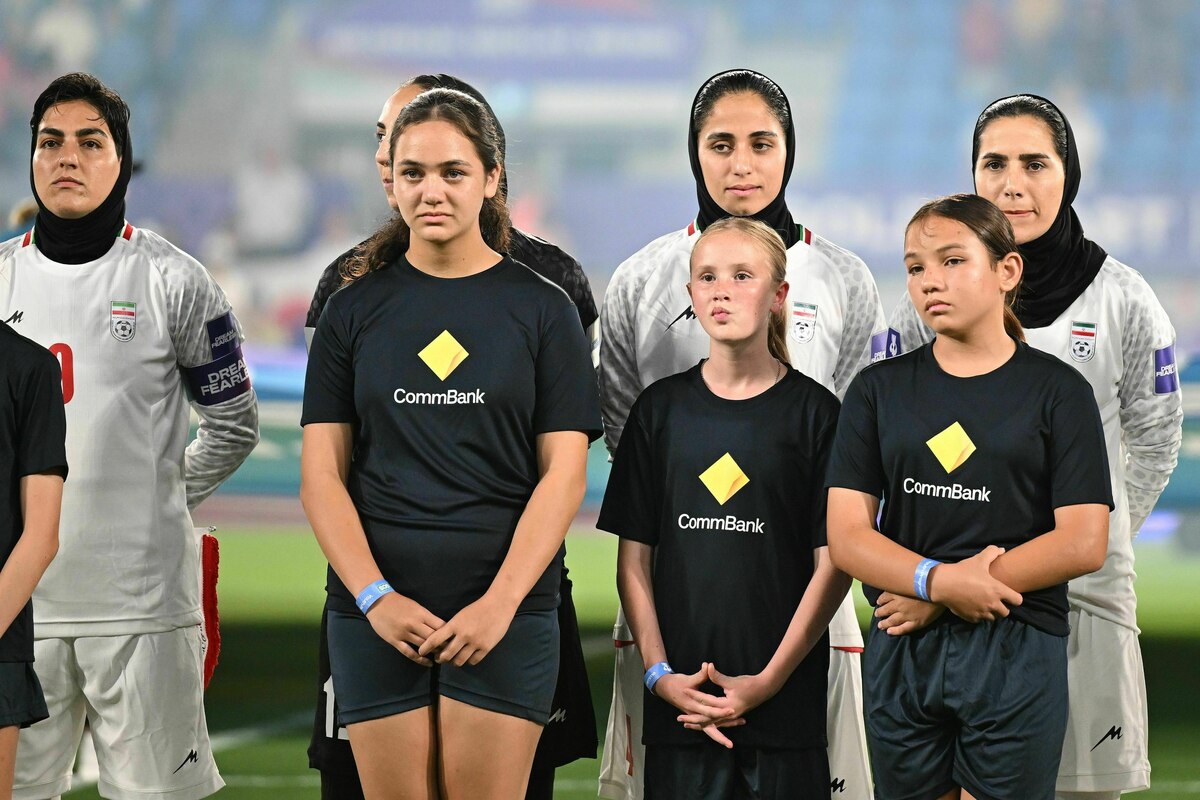
The regime apparently wants to suppress comments from prominent voices, out of concern about another wave of protests. The Iranian women footballers are currently taking part in the Asian Championship in Australia. Before their first match against South Korea, head coach Marziyeh Jafari was asked at a press conference for a comment on the political situation.
A few weeks earlier, two players had stepped down in protest against the regime. But a representative of the Asian Football Confederation (AFC) urged focusing on the sporting aspect. Right before kickoff, during the playing of the Iranian national anthem, the whole team demonstratively did not sing. A bold gesture. Iran lost the match 0:3.
Protest From Exile
Footballers who have retired and live in exile can express their protest more easily, but they also have to fear consequences. Ali Karimi, for example, had earned 127 international caps for Iran since the late 1990s, and between 2005 and 2007 he also played for Bayern Munich. Karimi has been critical of the regime for years and left Iran in 2022; since then he has had to change his residence several times for security reasons. Now, during the war, Karimi posts daily several photos and messages on Instagram; he has almost 15 million followers.
In doing so he also recalls the footballers who were killed during the suppression of the protests in January. For example, Salar Behdari, a first-division goalkeeper from Arak; assistant referee Saba Rashtian from Isfahan; or former professional Mojtaba Tarshiz from Andisheh. More than 30,000 people are said to have been killed during the protests, at least 20,000 were reportedly arrested.
Ali Karimi was also the one who called for the Iranian national team to be barred from international competitions. In January he and 19 other football personalities with connections to Iran drafted an open letter to FIFA. In it he wrote: “Football, as the world’s most influential social phenomenon, must not remain silent in the face of executions, murders, arbitrary arrests and threats against athletes.” Then and now FIFA has kept a stance of not taking a clear position.
Actually, the 2026 World Cup year was supposed to be an important year for Iranian football. But the tournament is taking place precisely in the United States, Canada, and Mexico. Already in Donald Trump’s first term, the US government classified the Iranian Revolutionary Guards as a terrorist organization in 2019. Iranians connected to the Revolutionary Guards are not allowed to enter the United States. This should also apply to football officials and possibly to national players like captain Mehdi Taremi, who completed his military service with the Revolutionary Guards.
After the January protests, skepticism within the Iranian football association seems to have grown. Two of the three group-stage matches of the Iranian team are planned to be held in Los Angeles, where the world’s largest Iranian diaspora lives. Protests against the regime would likely occur. In this context, some Iranian officials are said to welcome Iran’s exclusion from the World Cup, reports “Iran-Wire,” an exile media portal.
Suspended Play
Now, during the war, statements give the impression that the Iranian federation could withdraw its team on its own. “One thing is certain: we will not look forward to the World Cup with joy after this attack,” said federation president Mehdi Taj to the sports portal Varzesh3. “The US regime has attacked our homeland, and that cannot go unanswered.” The last time India withdrew from a World Cup was in 1950, at that time due to prohibitive travel costs.
Because of the forty-day national mourning for Ali Khamenei, play in Iran is paused. Iran’s World Cup preparation matches against Nigeria and Costa Rica, planned for the end of March in Tehran, may be canceled or played in another country.
During the protests in January, numerous football personalities expressed solidarity with the demonstrators. The Iranian U-23 national team refused to sing the national anthem before their first match at the Asian Championship in Saudi Arabia. Their coach Omid Ravankhah said at a press conference: “Under these circumstances it is my social duty to stand on the side of my people.”
After his return, Ravankhah was detained at Tehran airport and questioned for hours. Also arrested was former national player Voria Ghafouri, who had closed his cafés and called for protest.
After the killing of Ali Khamenei, current national players are keeping their messages clear. Otherwise they would risk their families and friends in Iran.