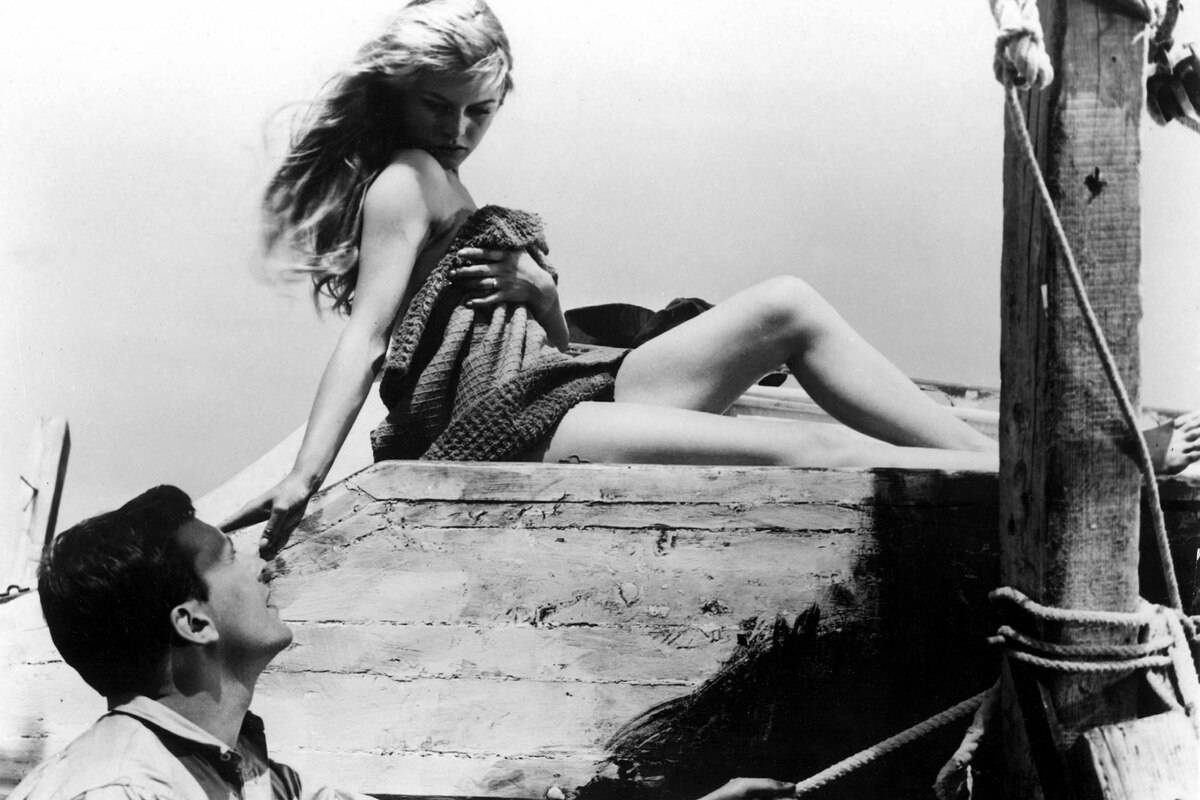
One of Brigitte Bardot’s early “scandal films” already carries its supposed scandal in the title: in “Manina, la fille sans voile,” or “Manina, the Girl Without a Veil” from 1952, the 18-year-old, in her second screen appearance, plays the daughter of a lighthouse keeper, whom the crew of a treasure-hunting ship falls for.
In a scene that at the time left audiences gasping, one of the men sneaks up on the sleeping girl and tries to kiss her. Upon waking, during the implied “sleep rape,” the girl’s loose bikini strap slips from her shoulder and exposes her breast. The equally stupid English title of the problematic black-and-white film harks back to the scene: “Manina, the Girl in the Bikini.”
Four years later Bardot withdraws into the role of female temptation before the lecherous gazes of several men, including older ones, in Roger Vadim’s “Et Dieu… créa la femme” — and the public and press focus on her breasts takes grotesque forms. Also in 1956 she appears in “En effeuillant la marguerite” (“The Daisy Is Stripped”), a student who wishes to win a striptease contest.
The Gaze of the Male Audience
With the so-exploitative as well as reductive “male gaze,” the actress thus had plenty of experience when she appeared in Jean-Luc Godard’s “Le Mépris” (Contempt) in 1963 — and for the first time seems to consciously resist exactly this gaze: In the legendary opening scene she lies naked beside the (clothed) Michel Piccoli, and asks him whether and how much he likes her various body parts, letting her body come into being through his eyes.
Yet as the film unfolds, in which the director Paul (Piccoli) sells his artistic concept for the sake of commerce, Bardot’s Camille turns away from him. She begins to despise him; she even, with a black wig or sunglasses, becomes visually another woman who clearly refuses consent: “It disgusts me when you touch me,” she tells Paul. “Why don’t you love me anymore?” Paul asks her later. And Camille replies, with a degree of laconically unprecedented calm: “C’est la vie.”
Even though the screenplay and idea came from Godard himself, who wanted to work through his own self-image as a filmmaker as well as a personal relationship, Bardot makes a statement with this film. She appeared after “Le Mépris” in a handful of “erotic films” such as the tame “Les femmes” by Jean Aurel, which in 1969 drew attention solely due to allegedly more explicit sex scenes. Or, again under Vadim’s direction, a ostensibly self-empowered, promiscuous woman in her penultimate film “Don Juan, ou si Don Juan était une femme” (“Don Juan, or If Don Juan Were a Woman”) from 1973. Yet the days of slinking beneath the gaze of a male audience were over. In 1973 she ended her acting career.
A year later Playboy celebrated the 40-year-old as an “ageless sex kitten.” But the self-styled men’s magazine has, as is well known, not understood the point to this day.