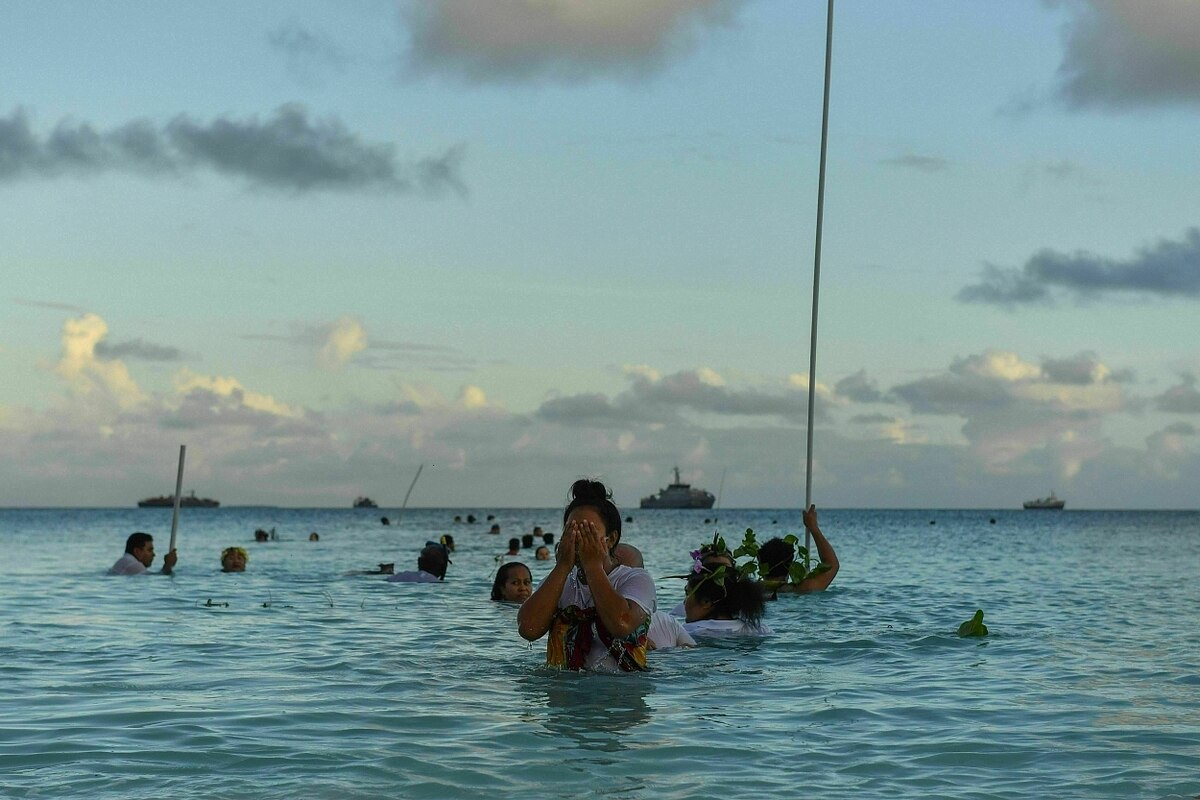
When I first learned about the climate crisis, I was in eighth grade. The word suddenly explained what I had felt long before. I was supposed to write an essay about it and I understood: that is the reason for the increasing number of cyclones.
Earlier no one asked why there were so many storms, which also occurred during the dry season. Once the road to my home at the northern end of Funafuti, the main atoll of Tuvalu’s nine islands, was completely flooded. We had to push our bicycles long distances to then ride home along another road farther from the coast. Sometimes school was canceled altogether because the storms were too dangerous. At the time we were happy about the days off, until we eventually realized how serious the climate crisis is.
Today Tuvalu is on everyone’s lips. Our government members travel around the world to tell about our fate, that is, how the climate crisis is destroying our country.
It is alarming how much has changed. It used to be warm outside; today it is so hot that I can no longer spend a whole day in the sun. This affects not only our daily life, it affects our entire way of living: how we grow crops, how we fish. Fish is actually our staple food, but large fish now only come to the table on special occasions. We Tuvaluans are deeply connected to nature. Therefore, when land, sea, and plants are no longer in harmony, we lose our identity.
Ten years of Refugee Summer 2015: The big questions from back then are the big questions of today – regardless of whether it concerns border controls, integration, or the AfD. explores answers in a special project.
Some families have especially close connections to nature. For example, those from which the best fishermen come; they know how the tides behave, where the fish are currently swimming, and where it becomes dangerous. This knowledge will no longer be passed on to the next generation. The sea is becoming less and less the place from which we feed ourselves daily. Instead, Tuvaluans are increasingly eating processed, imported foods, and as a result people here are more often overweight and sick.
Currently the Falepili Union between Tuvalu and Australia is the most-discussed topic on Tuvalu. Everyone is quite excited. It is a security and migration agreement that allows us to move to Australia – permanently or only for a time, as we choose. We can then live there, work, and go to school. This year the first 280 visas were issued.
It is frightening that our culture will disappear completely at some point
What might a policy look like that focuses on arriving rather than shutting people out? What can we learn from 2015? And where are the places where top-down restrictive politics meet a solidaristic bottom-up politics? We have dedicated five special issues on flight and migration in 2025 to these questions.
With the weekly issue of December 20, the project reaches its conclusion. It has not become a contemplative newspaper – but one that centers on a topic that takes on a special resonance at Christmas. We explore the question of what “home” actually is, what it takes to feel at home in a place – and how that hope is often destroyed.
All texts from this special issue appear here gradually. In the online focus you will also find the texts from the four previous special issues.
On the one hand, the agreement is a great opportunity. Especially people with families can find jobs there more easily. Recently I myself was in Australia and thought that everything is so much easier here and I feel safe. I wouldn’t have to worry; I could simply go to work every day and then go home. But at the same time I ask myself: If everyone leaves, what will become of Tuvalu?
The Tradition Is disappearing
We cannot simply run away just because a catastrophe is coming. What we have in Tuvalu is too unique for that. Many customs that define us could no longer be practiced. For example, I don’t think Australia would allow me to climb a tree at dawn and collect toddy. That is sap from the blossoms of coconut trees, which is processed into palm wine. We love it here.
You are reading a text from our Future section. If you’d like more positive perspectives, subscribe to TEAM ZUKUNFT, the constructive newsletter about climate, knowledge, and utopias. Every Thursday you’ll receive an email from us with strong thoughts for you and the planet.
🐾 Sign up now for the TEAM ZUKUNFT Newsletter – free
On the other hand, this tradition is also slowly disappearing in Tuvalu because the trees have little water due to the heat. Our culture is changing due to the climate crisis and migration. I find it frightening that it will eventually disappear completely. While there are many Pacific communities in Australia that meet for traditional weaving and dancing, I believe culture is rooted in a country. Because only there are all the resources to live it.
How else could you say you are Tuvaluan if there is no Tuvalu?
I think I have a responsibility to my homeland to help. Also, it is my right to stay here, even if Tuvalu is nearly swallowed by the sea. I know many people have mixed feelings about the Falepili Union offer. Not everyone wants to leave Tuvalu and live somewhere else. Why doesn’t Australia provide stronger support to those who want to stay?
For example, us who work in climate adaptation organizations in Tuvalu. We plant corals in the sea or distill water using solar energy in regions that lack access to clean drinking water. While we receive international aid, quite largely also from New Zealand and Australia – but Australia, as a huge coal and gas producer, keeps contributing to the climate crisis.
Ultimately, we can only rely on ourselves. How could you say you are Tuvaluan elsewhere if Tuvalu no longer exists? We must fight for Tuvalu and send a signal to other countries so that the impression emerges: if these small islands can act as examples, why can’t the whole world?