The geopolitical scenario in the Middle East has reached a boiling point that has forced the Spanish Ministry of Foreign Affairs, European Union and Cooperation to intervene directly in planning travel for its citizens. This March 9, 2026, the update of travel recommendations reflects a stark reality: the region is in a state of volatility not seen in decades, and what today is a functioning tourist destination could tomorrow become an airspace exclusion zone or an open front of combat.
Spanish diplomacy, through its network of embassies and consulates, has issued a detailed report classifying the countries in the area according to their level of danger. The central message is preventive: the Government cannot legally prohibit a citizen from traveling, but it strongly warns that, in the event of open conflict or border closures, the evacuation and consular assistance capacity will be extremely limited, if not impossible.
The «Axis of No»: Destinations banned for extreme security
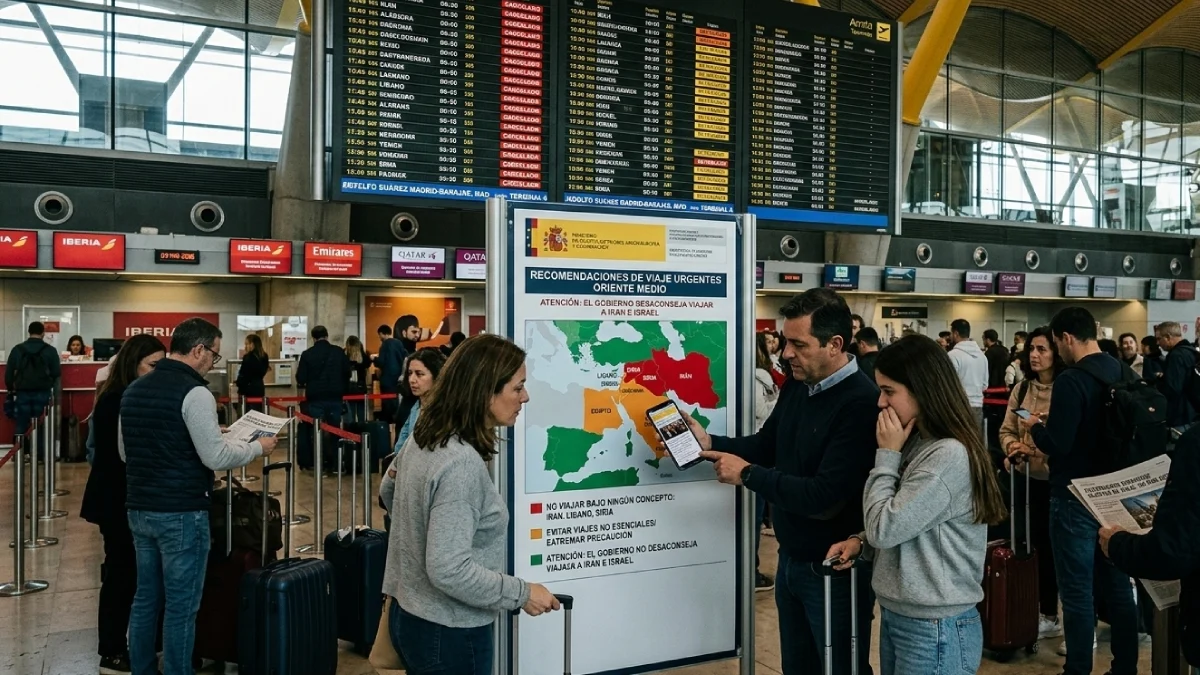
On the risk scale of the Ministry of Foreign Affairs, Exteriores, the color black identifies the countries to which it is recommended not to travel under any circumstances. In March 2026, this list is headed by Iran and the Lebanon.
The situation in Iran has shifted from tense to being considered an “extreme risk for Western citizens.” Exteriores warns that the risk of arbitrary detentions and the possibility that airspace could be closed without prior notice amid a missile exchange is extremely high. For its part, the Lebanon remains a practically prohibited zone for tourism. The ongoing bombardments in the south and the political instability in Beirut make the country a powder keg. The Ministry is blunt: if you find yourself there as a tourist, you are advised to leave while commercial flights are still operating.
These are joined by the already sadly habitual Syria, Yemen and Libya, where civil war and the presence of insurgent groups make any foreign presence a potential target for kidnapping or direct violence.
The dilemma of Israel and the Palestinian territories
For Israel, the recommendation has shifted from “caution” to “non-essential travel.” The Spanish Government recommends postponing any visit that is not for mandatory reasons. Although cities like Tel Aviv maintain a certain level of normal operation, the risk of saturation rocket attacks and the instability of the northern and southern borders make travel a security lottery.
Regarding the Palestinian Territories, the distinction is clear. Gaza is an active war zone with risk of death. In the West Bank, extreme caution is advised and the avoidance of any crowding is urged, as outbreaks of violence are sudden and difficult to predict. The Ministry also warns that border crossings with Jordan can close intermittently, leaving travelers stranded in no-man’s-land.
Tourism under surveillance: Egypt, Jordan and the Emirates
Countries that have traditionally been the engines of tourism in the region, such as Egypt and Jordan, remain in an orange color of “extreme caution.” Travel is not completely discouraged, but Spaniards are asked to limit their movements to strictly tourist areas and under surveillance.
- Jordan: The country is affected by social protests due to the neighboring conflict. It is recommended to avoid border zones with Syria and Iraq.
- Egypt: Travel through the Sinai Peninsula is completely discouraged (except the Sharm el-Sheikh complexes by air) and the border areas with Libya and Sudan.
- Turkey: Although geographically farther from the epicenter, Exteriores asks for caution in the southeastern provinces bordering Syria and Iraq.
The Travel Registry: The Last Line of Defense
In response to this crisis, the Government emphasizes a fundamental tool: the Travel Registry. It is a free app where every Spanish citizen leaving the country must register their contact information and location. In 2026, with artificial intelligence integrated into the MFA’s emergency systems, this registry is vital to locating citizens in case of a communications blackout or a large-scale attack.
Moreover, Exteriores issues a warning about travel insurance. In March 2026, many insurers have activated clauses excluding acts of war or terrorism. If a traveler decides to go to a zone discouraged by the Ministry, it is likely that their insurance will not cover medical expenses or repatriations, leaving the citizen with an enormous financial bill in the event of an incident.
The final recommendation is prudence. In a hyperconnected world, the desire to visit historic places clashes head-on with personal safety. The Ministry of Foreign Affairs is clear: the best way to protect oneself is, for now, to postpone the trip until the map of the Middle East stops burning.