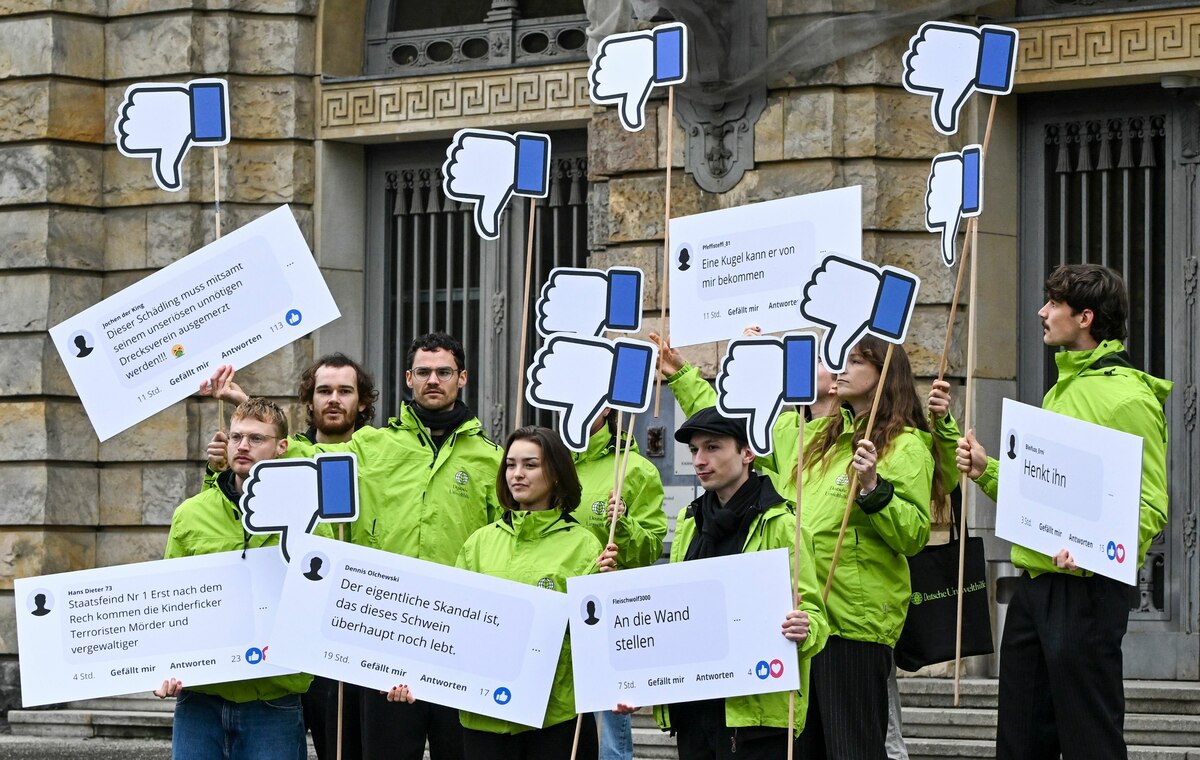
D The German Environmental Aid (DUH) does good work. Often, with its lawsuits, it pushes the sluggish politics forward. It ensures that environmental law is not just on paper but must be enforced.
In doing so, it ruffles some feathers, especially many car drivers hate the DUH. Such people often identify more with the crafty and deceptive car manufacturers than with environmentalists who work for clean air.
Thus arise Facebook groups like “Stop the German Environmental Aid,” where more than 50,000 people reinforce the view that the DUH, out of ideological stubbornness, harms the economy. That is nonsense, but undoubtedly protected by freedom of speech.
What is punishable is, however, when Jürgen Resch, the DUH’s managing director, is insulted in the vilest terms or when calls for his murder are posted. Resch had therefore sued Berlin courts to have Facebook delete these groups.
This was, however, rightly rejected by the Berlin Court of Appeal. Indeed, Facebook, as a host, is liable for its groups—but only if the group itself transmits hatred through its name and symbolism. So a Facebook group named “Kill Jürgen Resch” would of course have to be deleted, but the group was called “Stop the German Environmental Aid.” It would also have to be deleted if a group predominantly posted illegal statements. Yet in “Stop the German Environmental Aid,” the contents are, according to the court, predominantly legal.
That the Berlin verdict is correct becomes evident when you swap the players. Suppose there were a Facebook group “Stop the AfD” with 50,000 members and from time to time violence fantasies about Björn Höcke were posted there. One would also not think it right if a court, at the request of Björn Höcke, would now close the entire AfD-critical group on Facebook.
Surveillance Is Not the Solution Either
But the second, belatedly filed request by Resch that Facebook should better “monitor” the group “Stop the German Environmental Aid” in the future is also problematic. The aim would be that Facebook automatically reviews all contents in this group and deletes those that are punishable—either by moderators or by technical upload filters and algorithms.
Whoever finds that appealing, should remember March 20, 2019, when nationwide 200,000 young people demonstrated under the banner “Save the Internet” against the EU copyright reform, which supposedly prescribed upload filters. Those who see the solution to societal conflicts in upload filters merely give right-wing extremists a new invitation to pose as partners of the young civil society.
For upload filters are dangerous when they exclude not only very specific motives but also anything that looks similar or is in any way forbidden. It will lead to overblocking, or at least many will believe so and move toward fundamental opposition.
Therefore, the current solution is certainly more democracy-compatible: that the affected individuals themselves (and not Facebook) handle finding and reporting criminal insults and calls to violence. Of course, it is unreasonable that they actually have to do this personally. Jürgen Resch is absolutely right about that. But there are commercial agencies and civil-society associations that can mobilize providers and, if necessary, the police.
The more hate spreads, the more such self-defence initiatives will be necessary. That will entail costs, which are presumably borne by Jürgen Resch’s organization, the German Environmental Aid. And for free activists there must be civil-society–funded pools that can help. This is not pretty, but it is the price of freedom of expression.