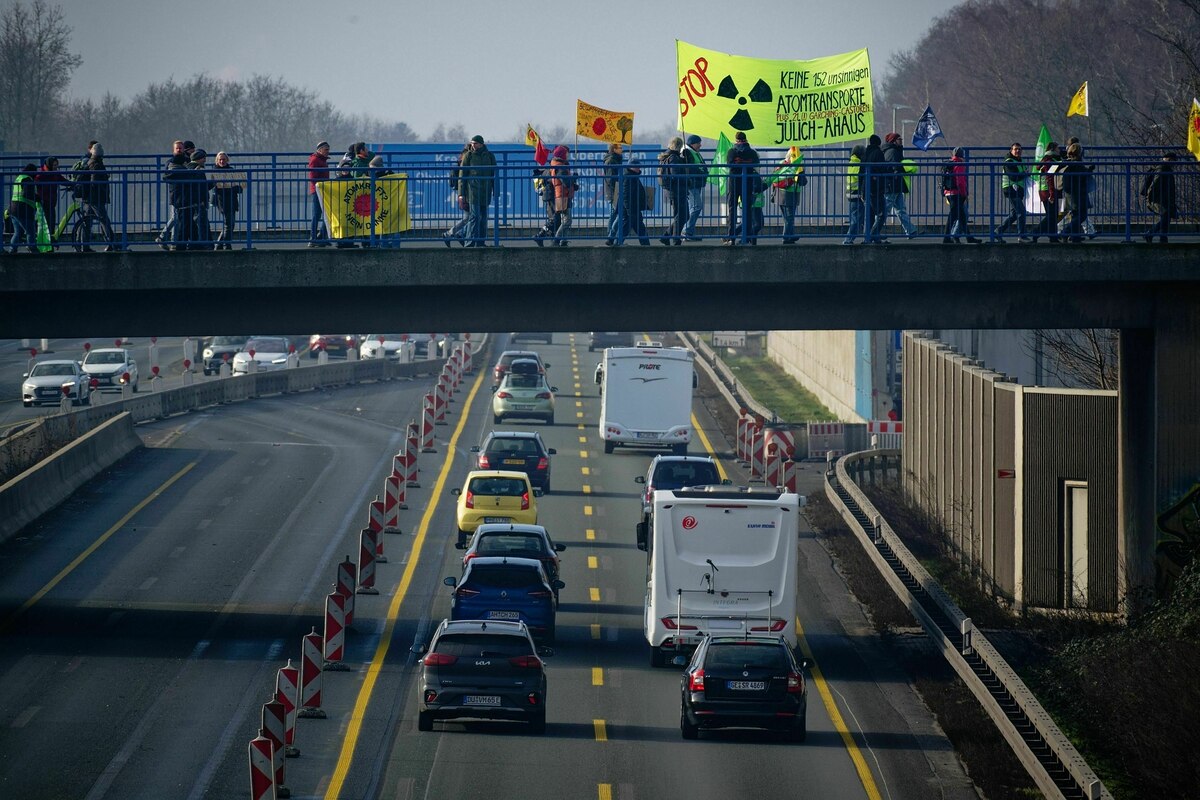
In just a few days, radioactive fuel elements from the Jülich Research Centre could roll right through the densely populated areas of North Rhine-Westphalia toward the interim storage facility in Ahaus. „I think it will start next week or the week after,“ said Kerstin Ciesla, deputy state chair of the Bund für Umwelt und Naturschutz (BUND) in NRW, to .
„Despite years of warnings and protests, the Castor casks could roll as early as next week,“ also believes Matthias Eickhoff from the Münsterland Alliance against Nuclear Installations. Also, a spokesperson for the Jülicher Entsorgungsgesellschaft für Nuklearanlagen (JEN), which is pushing ahead with the transport of the fuel elements, spoke to in response to a query of a timeframe of „a few weeks.“
The background is a decision known late Monday afternoon by the Berlin-Brandenburg Higher Administrative Court (OVG). The environmentalists of BUND were forced to take action against the Castor transport permit in Berlin courts – because the permit had been issued by the Federal Office for the Safety of Nuclear Waste Disposal (BASE), which in turn falls under the SPD-led Federal Ministry for the Environment.
At the beginning of January, the Administrative Court Berlin had ruled that BUND was not entitled to sue at all. This decision was overturned by the higher court on Monday. Substantively, however, the second instance did not follow the environmentalists’ argument that the transports are dangerous and only inadequately safeguarded against drone attacks: even though parts of the administrative files were available only redacted for security reasons, the transport permit issued by BASE was “not evidently unlawful.”
Decision is final and unappealable
It was „not evident“ that the defendant could have underestimated the danger of drone attacks on the transports, the OVg concluded despite the redacted permit documents. The decision was „unappealable.“
„We are speechless,“ says BUND state vice-chair Ciesla. „Despite doubts about safety, highly radioactive transports are now supposed to roll across the country.“ The OVg decision is „out of date,“ also says Helge Bauer of the anti-nuclear organization auszugsstrahlt: „Iran’s call for retaliation strikes in European states also concerns the planned Castor transports.“
SPD and the Left Party in North Rhine-Westphalia criticize the upcoming transports. The Black-Green state government violates its own coalition agreement, which promised the „minimization of nuclear transports,“ says André Stinka, the SPD state parliamentarian on energy policy. „I stand by it: at the latest when the first Castor rolls, the resignation of Green state Minister Mona Neubaur, responsible for nuclear oversight, is overdue,“ says Hubertus Zdebel, the Left Party’s nuclear policy spokesperson in NRW.
State Government Also Has Concerns
Even within the NRW state government itself, concerns about the transports appear to be growing: „If it were up to me, I could gladly do without the upcoming Castor transports,“ NRW Interior Minister Herbert Reul tells . The police will, however, „do their job and accompany this operation professionally.“ The chairman of the Police Union (GdP) in North Rhine-Westphalia, Patrick Schlüter, simply calls the transports „madness“ with „consequences for security in the state.“
As the Left Party and parts of the SPD and Greens call for action, anti-nuclear initiatives, climate groups, and churches are therefore calling for next Saturday at 11:30 a.m. an anti-Castor demonstration in front of the town hall in Ahaus. The following Monday, Interior Minister Reul, who will be in Ahaus as a guest, is to be reminded of his responsibility with a vigil.