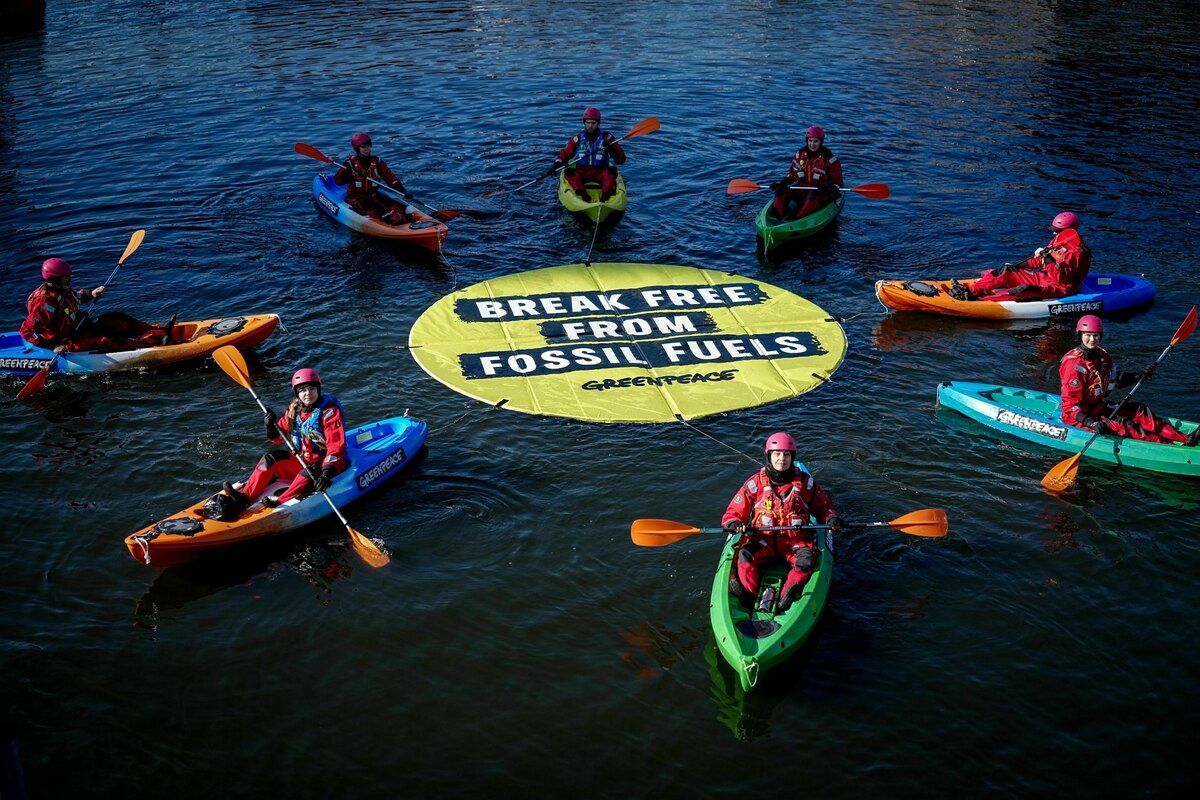
Climate policy also provides solutions for the energy crisis, said Environment Minister Schneider. To put pressure on the government, Fridays for Future is calling for demonstrations.
dpa/epd | The Greenpeace activists in kayaks on the water at the Berlin conference center at Westhafen had a clear message: “Free yourselves from fossil energies!” Inside, Federal Environment Minister Carsten Schneider spoke almost as clearly. The dependence on fossil energy such as oil, gas or coal is an incalculable risk, even for Germany, the SPD politician said at the opening of the 17th Petersberg Climate Dialogue. “Renewable energy sources are, by contrast, security energies.”
The climate dialogue is an informal gathering of around 30 changing states, which the government traditionally invites in the spring. It is about diplomatically preparing the next UN climate conference, which is to take place this year in Turkey.
“Climate policy provides the solutions so that the next fossil energy crisis hurts less,” Schneider said at the opening of the meeting. There are already good countermeasures with renewable energy, electric mobility and heat pumps. “Therefore I am convinced: this current fossil energy crisis will act as an accelerator.”
That this will become a self-running process is not believed by everyone. The climate initiative Fridays for Future has announced demonstrations in 70 German cities for Friday. Last Saturday, tens of thousands of people in four major cities had already demonstrated for more climate protection and the energy transition.
Fridays for Future: Economy Minister in a “Gas Frenzy”
Fridays for Future explained that Federal Economy Minister Katherina Reiche (CDU) is “in a gas frenzy.” In view of the escalating climate and energy crisis, the minister is accused of “closing her eyes to reality.” Gas drilling in the Wadden Sea and in Upper Bavaria, liquefied gas terminals on the coasts, and increasingly many gas-fired power plants are presented as expressions of Reiche’s “destructive energy plans.”
“Energy policy may seem abstract to many, but rising prices are felt directly in everyday life,” it continued. Refueling, heating, and groceries are already expensive due to the Iran War and dependence on fossil fuels, and prices are expected to rise further: “We make visible what political decisions actually cost people, today and in the future.”
Together for a Free Press
As a cooperative, we belong to our readers. And our journalism is not only 100% independent of corporate interests, but also freely accessible. We make all articles freely available, without a paywall. Especially in these times, classifications and information must be accessible to everyone. Our readers do not have to pay, but know that critical, independent journalism does not arise from nothing. We are very grateful for that. In order to continue doing our journalism tomorrow as well, we need more support. Our next target: 50,000 – and with your participation we can achieve it. Make a statement for and for the future of our journalism. With just €5 you can join!
Support now