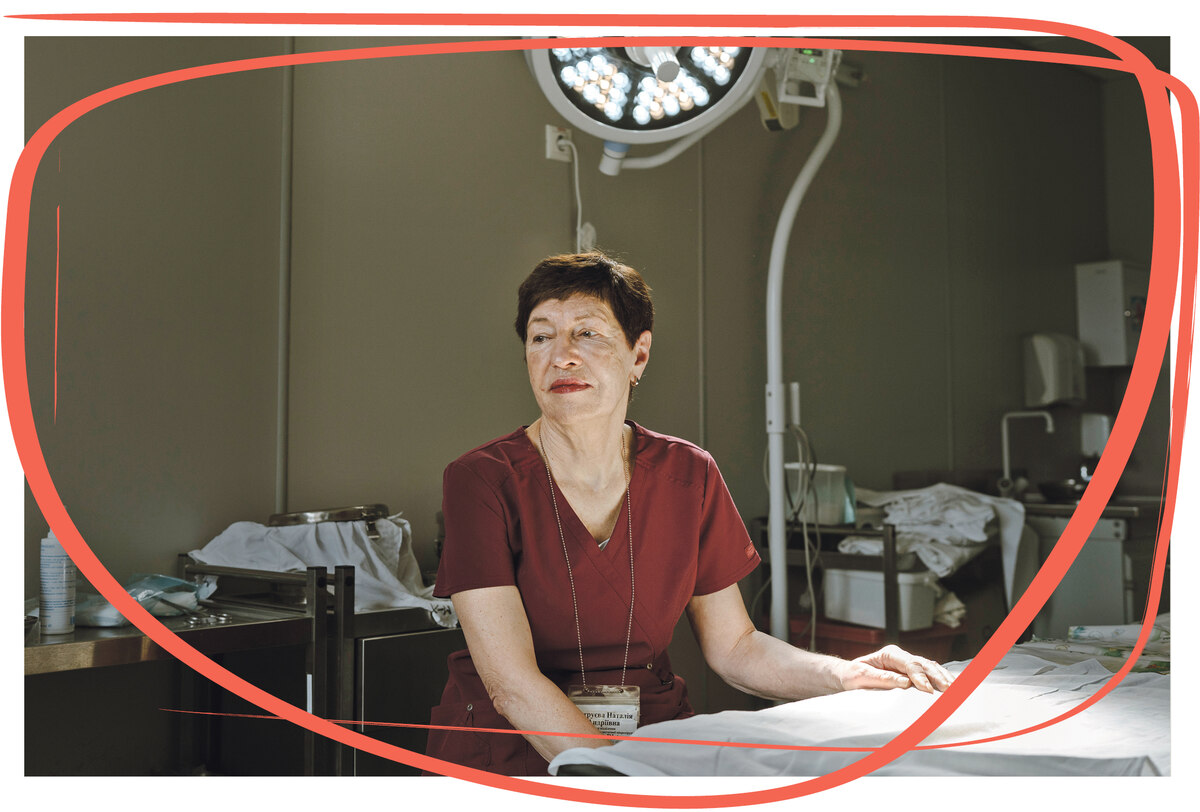
Deeply etched in her memory is July 8, 2024. Nataliia Tetruieva was on her way to the operating room when a rocket struck the Ochmatdyt Children’s Hospital in Kyiv. At that moment important operations were underway, she says; the children had been under anesthesia. They quickly had to move the patients from the endangered building to a safe place, she continues. A colleague died during the evacuation.
For the feminist campaign day on March 8, the wochen becomes feminis. While rights of women, trans, inter, and non-binary people are under attack and pushed back worldwide, the issue asks what can help against powerlessness and bewilderment. Our answer: solidarity. On 52 pages, feminis shows how solidarity is lived on both large and small scales. The topic is also tracked on .de for four days. You can read the full editorial here.
Operating in times of war? Must a doctor endure that? “We physicians are accustomed to dealing with life-threatening situations,” says Tetruieva. She is one of Ukraine’s most renowned surgeons, having worked as a doctor for decades. Her task is also to prevent panic and chaos in emergencies, she says – including on February 24, 2022, the day Russia attacked Kyiv and other Ukrainian cities.
When Tetruieva says this, it sounds sober and self-evident. And yet it is not in a country that has been under constant bombardment for 1,472 days. In the early months of the war, not only children with congenital facial and jaw malformations—as usual—arrived at the hospital, but also injuries of people of various ages from Kyiv and the surrounding area.
Many longer-term planned surgeries for children had to be postponed. Tetruieva acted immediately after the start of Russia’s full invasion; she called her patients to determine who needed immediate surgery and for whom a postponement would be medically justifiable.

In knowledge of networks lies a great deal of power. Those who know who is connected to whom remain capable of acting and resilient. On the international day of feminist struggle, we want to make visible people who work for a life that respects everyone’s rights. They too have networks. We started at our doorstep and set out to search. We wanted to know: Who lives and fights in solidarity? And we met people who had been completely unfamiliar to us until recently.
Nataliia Tetruieva is a professional in her field. Since 1991 she has been the head surgeon of the Department of Plastic and Reconstructive Microsurgery at Ochmatdyt, the largest children’s hospital in Ukraine. During this time she also began to build an interdisciplinary center for pediatric jaw and craniofacial surgery.
Tetruieva operates on children with congenital malformations, cleft lip and palate, tumors and severe facial injuries. “The most important thing in this challenging work is teamwork,” says Tetruieva. Speech therapists, surgeons, orthodontists, psychologists, operating room assistants, and even those who organize recreational programs for the children during treatment must work together. “The further development of the patients is as important as the treatment of jaw and facial malformations,” says Tetruieva. Even after successful surgeries, many children still struggle with speech disorders.
In 2022, the surgeon was named “Health Hero” by the organization Women in Global Health. She was recognized for her work under the difficult war conditions. It remains a challenge to organize timely help for patients from frontline areas and occupied territories. Tetruieva and her team run training for professionals from all over Ukraine; they offer online courses for patients, together with speech-language pathologists.
Since the start of Russia’s full invasion, the job market in her field has changed. Significantly more women have taken on leadership roles in healthcare. That is a good development, says Tetruieva – because many stereotypes about doctors, both male and female, still exist.
It is more important than ever to ensure equal opportunities for all professionals, regardless of gender; only then can a stable and effective healthcare system exist in Ukraine. Learning, sharing and passing on knowledge—that motif runs through Tetruieva’s entire life. Perhaps that is why she repeatedly emphasizes that, despite the war, the hospital tries to maintain contacts with professionals in the United States and in Europe and to adopt modern treatment approaches.


Today Tetruieva is 77 years old. She could actually retire. But she remains on duty, continues to operate, holds consultations for patients, conducts research, and shares her knowledge at international conferences.
In the meantime, hospital staff have also resumed their regular work. Normalcy in a state of emergency. There is a phrase Nataliia Tetruieva has repeatedly heard from the children who come to her: “I want to look like the others too.” In surgery, it is about far more than appearances—about self-confidence and a better quality of life.
And especially in these times, Tetruieva wants to contribute in this way.