G If it were up to Maria Kuban, the electronic display boards beside streets and highways could soon bear messages like: “Warning, extremely high-dosed heroin in circulation,” or: “Warning, unusually many drug-related deaths.” Just like in Ireland. When, at the end of 2023, 57 people in Dublin died within a few days from overdoses, warnings about extraordinarily strong drugs were issued on the roads. In Germany, however, the signs only carried phrases such as: “Warning, traffic jam on the A100!” “Would anyone in a German city know whom to call to spread warnings on an information board?” she asks.
Kuban, 31, is a substance-use expert with the German AIDS Help and is looking for ways cities can prepare for the spread of synthetic opioids.
Synthetic opioids are extremely potent drugs produced in laboratories. Nienes are among them, as is fentanyl, which is widespread especially in the United States. Nienes were originally developed as painkillers but were never approved because they are too potent and the risk of overdose would be too high.
Kuban sits in her office, raising a pen to illustrate the unimaginable potency of these substances: “Two hundred milligrams of heroin are a lethal dose if you are not accustomed to it. With fentanyl, it’s only two milligrams. That is a amount as small as the tip of a pencil.” In comparison to heroin, nienes are even 500 times stronger. The small amounts can be smuggled more easily—and a few crumbs mixed into a bag of heroin can be deadly.
That synthetic opioids are now spreading in Germany is linked to the power shift in Afghanistan in 2021. For decades, almost all heroin came from Afghanistan; over 80 percent of the world’s opium was produced there. But the Taliban banned the cultivation of poppy, from which heroin is derived, four years ago. On the global heroin market, a gap remains even according to United Nations assessments. And, Kuban fears, this gap could be filled with stronger synthetic opioids.
“The demand for heroin does not change with the supply,” she says—unlike drugs like cocaine, where the available amount also affects how much is consumed. Even if Afghanistan supplies less heroin, opioid-dependent people will need substitutes. The dependency is too big. In the early 2000s, Estonia faced a similar situation, Kuban notes; heroin became scarce. “Fentanyl labs sprang up incredibly quickly to compensate.” It is only since 2017 that the fentanyl crisis in Estonia has been overcome.
Maria Kuban leads the So-par project of the Deutsche Aidshilfe and the German-European Forum for Urban Security, which at its core is about being prepared for situations like in Estonia. It is about the question of how to get ahead of the wave, instead of being overwhelmed by it. If synthetic opioids continue to spread, how should one prepare?
The first goal of the So-par project, the cryptic acronym stands for “Synthetic Opioids – Prepare and Response,” is to determine how widespread synthetic opioids on the black market already are. For in Germany there are hardly any numbers about which substances are circulating, how high their doses are, and what they are made of.
The Berlin police told that they have no indications that synthetic opioids are spreading in Berlin to an “alarmingly high” extent. Which drugs are sold on the black market, however, the police know only to a limited extent. Last autumn it warned about counterfeit oxycodone and Xanax tablets that contain nienes and are circulating across Germany.
A year after the cultivation ban in Afghanistan, between 2023 and 2024 the purity of street heroin in Germany fell from 32.5 percent to 11.3 percent, according to the German Monitoring Centre for Drugs and Drug Addiction. The loss in quality is partly offset by fentanyl or nienes mixed into the heroin. Hendrik Streeck, known as the virologist from the Corona pandemic and now the Federal Government’s drug commissioner, therefore spoke in February of a “highly dynamic development on the drug market” and called for more decisive action now, as the data are too incomplete.
Fresh Pipes and Syringes Here
In the Birkenstube drug consumption room in Berlin-Moabit, the issue has long since arrived. On the door is a bright orange sign: “HEROIN? TEST FOR FENTANYL!” In the large room with opaque windows and tiled walls, six metal tables stand along the wall, each with a container for used syringes. Here people can be looked after and thus consume drugs more safely. They receive fresh pipes or syringes and are medically cared for.
So far, consumers could test their heroin here with a rapid test for fentanyl. Whether and how much fentanyl was actually present remained unclear. The Birkenstube staff, on a positive test, could only advise the consumer to approach cautiously and take less than usual.
Since March, however, the Birkenstube has been part of Maria Kuban’s project. For seven months, samples of the drugs from the consumers will be taken. In the laboratory, they will be analyzed to determine which substances they consist of. Testing is also being conducted in other consumption rooms in Hanover, Essen, and Berlin.
It is hardly possible to determine how widespread synthetic opioids are by any other means. Wastewater tests, which, for example, give clues about how much cocaine is consumed in a city, are not suitable for synthetic opioids, says Kuban. It is about too small quantities. Moreover, fentanyl is also used as a painkiller. So traces of fentanyl also end up in wastewater from hospitals, not only from drug users.
In Berlin there is actually already a drug-checking offer, where drugs can be handed in for free. A few days later you get them back with a test result. A very advanced concept, in Kuban’s view. For people from the open drug scene, however, it is not suitable. “If someone is opioid-dependent, they cannot wait four days for their heroin,” says Kuban. Therefore, so far hardly any samples from the open drug scene have been examined at the drug-check point. This should change with samples from the consumption rooms.
Why is it even taken as given that drugs have to be bought in a dark corner? No one knows how clean the drugs are. Money flows into illegal structures. Maria Kuban would therefore shape drug policy completely differently for success. For decades consumers have been criminalized and stigmatized, and the situation has not improved as a result. “Politicians should finally admit that prohibition has failed,” she says.
Instead of punishing people for their drug addiction, drug distribution would have to be regulated by the state. A positive example is the diamorphine provision, in which opioid-dependent people receive pure heroin in a medical setting. This could curb illegal drug trafficking and consumers would not die from contaminated drugs. “There are people who have depended on the black market for 30 years to get their drugs,” Kuban says, “that is a daily new risk.”
In comparison, the number of drug-related deaths in Germany is high: about 25 percent of drug deaths in the EU occur in Germany. In 2024 there were 2,137 deaths, according to the statistics of the Federal Drug Commissioner. The number of victims under 30 is increasing because younger people tend to experiment with drugs and try unfamiliar substances they order on the Internet.
The dark figure is likely even higher. In February, a study from King’s College London was published showing that deaths due to nienes are likely underestimated. Nienes degrade quickly in blood samples taken after death and therefore can often not be identified as the cause of death. The researchers thus estimate about a third more deaths due to nienes.
The Consumers Are Much Younger Than Ten Years Ago
Back in the Berlin-Moabit consumption room, in the middle there stands a waist-high oxygen cylinder. When Birkenstube is open, a staff member sits here to monitor if someone feels unwell after consumption. If the lips turn gray? Does the person react slowly or lose body tension? Is the breathing weak? In case of signs of an overdose, staff can provide oxygen—or Naloxone, the direct antidote to opioids.
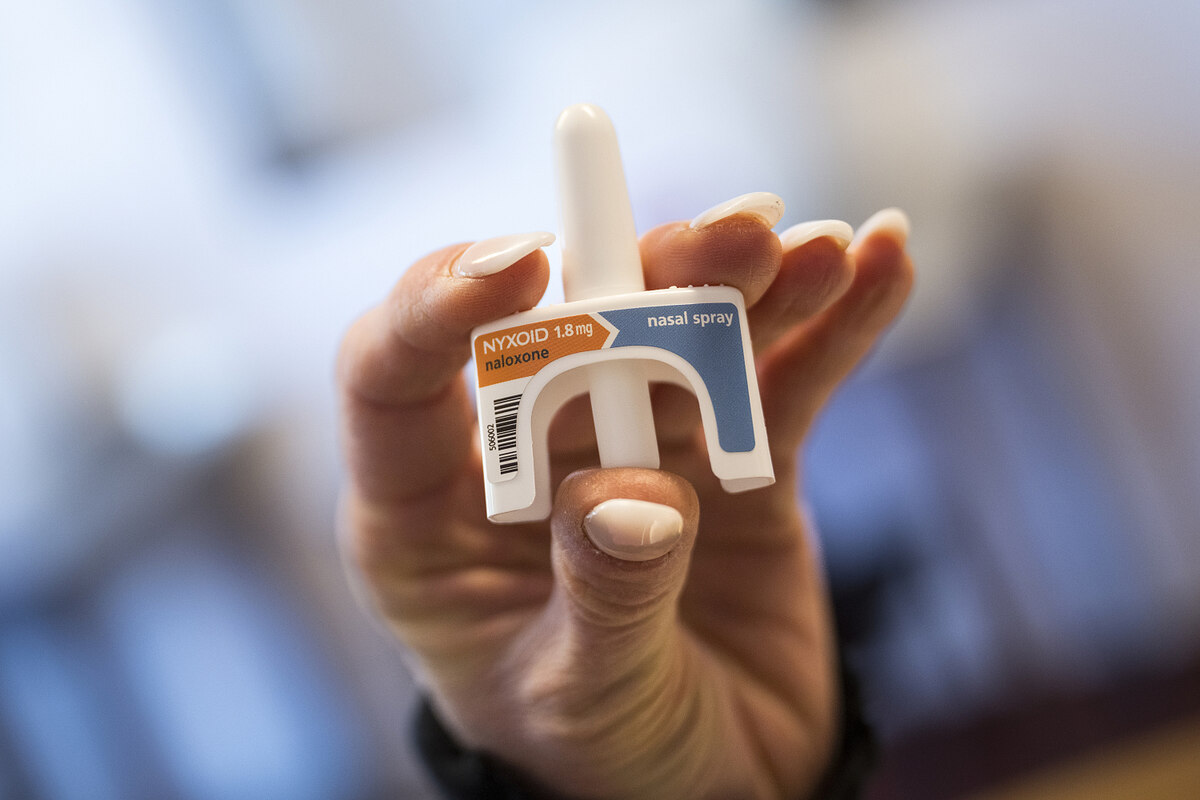
In Canada, opioid users carry their Naloxone nasal spray visibly in a belt pouch. If someone goes blue or lies unconscious on the street, bystanders can help directly. “Most people in Canada, especially those who work with opioid users, know Naloxone,” says Maria Kuban, “They know how to administer the spray and can recognize an overdose.” Canada is thus the model for Kuban’s second goal: making Naloxone more widely known in Germany – among people who use opiates, in their circle, among social workers, and ideally among kiosk owners in neighborhoods with an open drug scene.
On a Monday morning in March, seventeen street workers crowd around a table at the drug-emergency service. They are here for a Naloxone training. Most work with teenagers. “Drug use is a huge issue for us,” says a social worker from Berlin-Friedrichshain. “Pot, benzos, coke, even harder stuff, crack, heroin – all of it.”
“The consumers are much younger than ten years ago,” says Nicole Weizmann, “that’s why you’re here.” Weizmann is herself a street worker and works in a drop-in café for people who use drugs. She trains the group with a colleague and passes around a Naloxone kit. In the metal box are two individually wrapped Naloxone sprays. “Very important,” she emphasizes, “each spray contains only one puff.” You can’t test the spray and spray it into the air like a cold-relief spray.
Weizmann explains the procedure: First you must call an ambulance. You lay the person on their back and gently tilt their head back so they get good air. Then you insert the spray into a nostril and press.
In the brain, naloxone binds to the opioid receptors within a few minutes. This blocks the effect of the opioids. Naloxone itself has no intoxicating effect. Therefore, it is not a problem to give the nasal spray to a person who did not overdose on opioids but on another drug.
A man asks. Whether she has had to use Naloxon in her daily work, he wants to know. Last year twice, says Weizmann. “The person then comes back so quickly that you are shocked. As if they had risen from the dead.”
Naloxone Should Be Available for Purchase by Anyone
When the person regains consciousness, they may experience withdrawal symptoms. Sometimes people become angry because the urge to use returns, explains Weizmann to the group. It is then very important to explain to them that the effect of the opiates returns. After twenty to thirty minutes the Naloxone wears off and the opioids regain the upper hand. If the dose was very high, it can even lead to another overdose.
The street workers in the room come across as convinced. There is no risk, if another drug caused the overdose, the spray works quickly and is very easy to administer. How to obtain Naloxone is something several people want to know.
That Naloxone has become more interesting for street social workers also ties to a decision by the Bundesrat in October 2025. Since then, certain professional groups that work with opioid users can obtain a Naloxone prescription. Previously this was only possible for the users themselves. In the future, Naloxone should be purchasable over the counter in pharmacies by anyone.
But suppose several people in Birkenstube felt very unwell after taking their usual heroin dose and needed Naloxone. At the same time, several people would be admitted to hospital with overdoses. Then the doctors in the emergency department would not know about the overdoses in the drug consumption room, or vice versa — that is Kuban’s third problem.
A Crisis Team Is Needed Against Synthetic Opioids
Warning signals such as clustered overdoses are not linked in Germany so far, even though they point to contaminated drugs that could be life-threatening.
In danger situations like a potential flood, a crisis team takes the lead, says Kuban: Warnings are shared via apps and sirens, the fire department and the Federal Agency for Technical Relief are alerted, gymnasiums are prepared as emergency shelters. Such a system would be needed if there is danger from synthetic opioids as well.
Her goal is, therefore, that at the municipal level a crisis team for overdoses is formed and that communication chains arise — up to the traffic signs. If the hospital notices that suddenly twice as much Naloxone is being ordered because it is being used much faster, that information should not be lost.
The approaches to solutions could be as simple as a shared email inbox for the fire brigade, drug consumption rooms, police, drug self-help groups of a city and all hospitals, says Kuban. This would allow toxicology results, reports from the drug scene, or unusually high Naloxone orders to be shared between institutions.
Even if the police ensure counterfeit tablets are seized, some of them might already be circulating, and the information is crucial for emergency medics. All of this information should flow together in one place to detect anomalies immediately.
If you do not give people controlled access to drugs, at least you must build a functioning early warning system, says Maria Kuban.