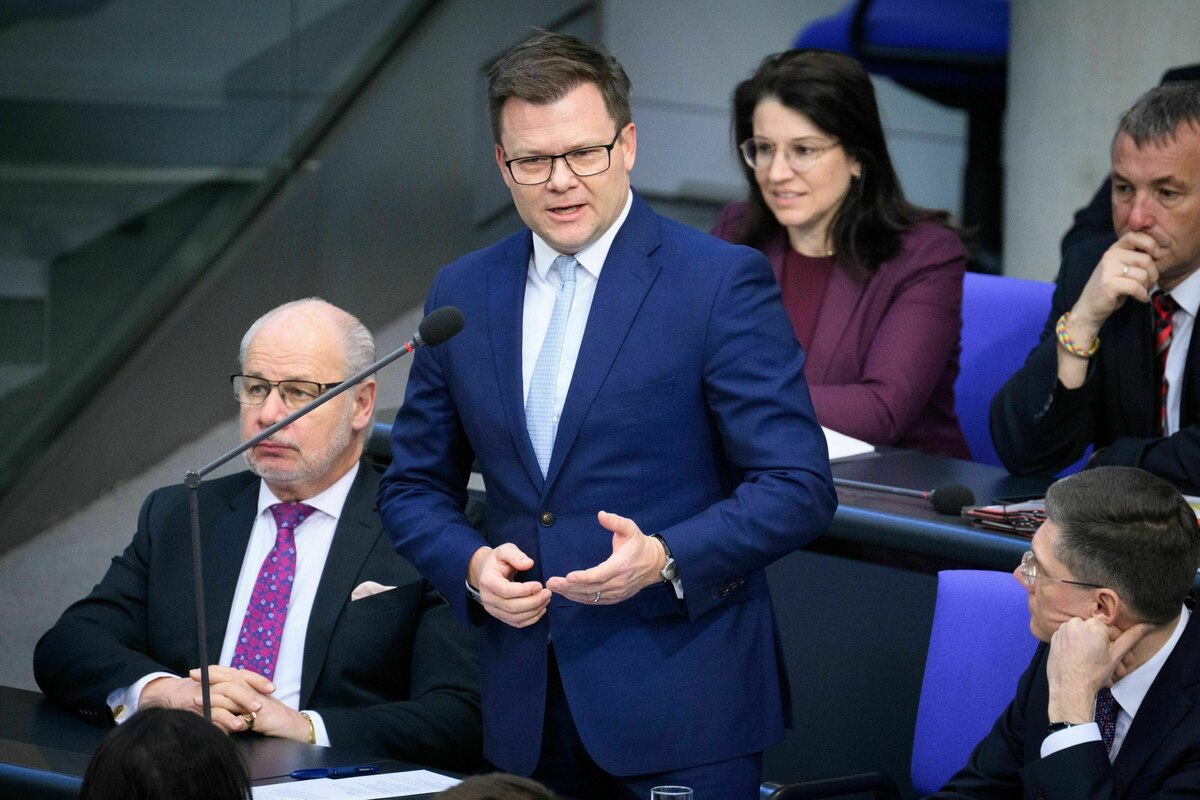
Hope for reason and respect for Parliament: Federal Environment Minister Carsten Schneider (SPD) had nothing more to offer against the accusation that the planned reform of the Heating Act is not compatible with Germany’s climate targets. “I respect the Parliament’s decision and will not comment on it,” he said on Wednesday in the Bundestag.
The leaders of the governing coalitions CDU/CSU and SPD had agreed last week on the key points for a reform of the Building Energy Act, known as the Heating Act. Among other things, the rule would be scrapped that, depending on locality, from summer 2026 or 2028 new heating systems have to run with at least 65 percent renewable energy. Instead, gas and oil heating systems would be allowed to continue to be installed without restrictions, but from 2029 they would have to operate with 10 percent “green gas” or “green oil”.
An Öko-Institut study suggests that this reform would widen the gap to meeting the climate targets even further: According to the study, Germany would miss its climate target for 2030 by 30 to 33 million tonnes of CO₂ if the reform is implemented as announced. So far the gap according to the Umweltbundesamt stands at 25 million tonnes of CO₂. By 2030 Germany must reduce its CO₂ emissions by 65 percent relative to 1990 under the Climate Protection Act.
By 2040, the CO₂ reduction should be 88 percent relative to 1990. With the reform of the Heating Act, the gap to this target would also widen according to the Öko-Institut: by 14 to 22 million tonnes of CO₂, bringing it to 116 to 124 million tonnes of annual CO₂ emissions. What is crucial is precisely the 65 percent rule, which CDU and SPD now want to abolish: The Öko-Institut says it accounts for 80 percent of the climate protection effect of the existing Heating Act.
Climate protection program deadline puts pressure
“With this costly heating law, green investments will be slowed and the huge climate gap in the building sector will grow,” commented Lisa Badum on the study results. She is the climate policy spokesperson for the Green Party faction in the Bundestag. “I am baffled as to how a legally secure climate protection program could be possible under these conditions,” she said.
Environmental Minister Schneider must present a climate protection program by March 25 that explains how the federal government intends to meet the statutory climate targets. Which measures should compensate for the additional emissions from the planned reform of the law remains unknown. Also in the Bundestag’s Environment Committee, a representative of the ministry could not provide an answer to corresponding questions from the members of parliament, as learned from participants in the non-public session.
„It became clear that the environment ministry has no plan for how the emission gap created by the reform should be closed“, said a committee member. „The ministry has not further specified how the additional emissions are to be offset.“ Another committee member added that the ministry’s representative did not want to quantify the emission gap yet, “because only the key points for the reform have been presented.”
Schneider: “Rely on Reason”
Precisely, Environment Minister Schneider could not say more on request in the Bundestag. He respects the Parliament’s decision, both regarding the Climate Protection Act, which prescribes CO₂ reductions, and regarding the coalition factions’ guidelines for the amendment to the Heating Act.
“We are leaving the decision on how to heat to the owners,” said Schneider. He warned that installing a gas heating system is “a cost risk.” Therefore the federal government will provide subsidies for heat pumps. “We are counting on the owners’ sense of responsibility,” he said. It is necessary to create incentives for landlords to invest in sustainable heating “and for tenants not to pay the price.”
Schneider stressed that “we must do everything to become independent from energy imports.” Currently, as at the gas stations, where the oil companies raise fuel prices in response to the Iran war, “we see how vulnerable we consumers are.” Imports of fuels such as oil, gas and coal would have to be replaced by wind and solar power as well as energy-saving measures. How that fits with the ongoing installation of oil and gas heating systems, he did not say.