D Kosovo takes its name from the blackbird – in Serbian “Kos”. The black birds in the trees along Pristina’s pedestrian zone screech loudly as the sun sets. People gather at this hour to break the fast. It is Ramadan, the overwhelming majority of Kosovo’s inhabitants are Muslim Albanians.
Children play merrily on the squares in the center of the capital. I am impressed by the relaxed atmosphere. Yet here, in 1998/99, a war raged. The disintegrating Yugoslavia under the leadership of the alleged Serbian war criminal Milošević claimed full control over Kosovo, which had been largely autonomous until 1989.
This, in turn, demanded self-determination and stood up to the pan-Serbian ambitions — first with nonviolent resistance, then also in armed fighting.
Yelizaveta Landenberger
writes as a freelance writer for the , regularly covering Eastern Europe and the West.
After there were numerous crimes committed against the Kosovar civilian population by Serb troops, NATO forces bombed military and strategic targets in Yugoslavia. This was done without a UN mandate, as Russia and China had threatened to veto in the Security Council.
Duty to Protect
NATO wanted with its intervention to prevent a genocide of the Serbs against the Muslim population, as the world had allowed in Bosnia a few years earlier. In 1995, soldiers of Republika Srpska massacred 8,000 Bosnian men in Srebrenica.
For the intervention, Kosovo — which declared its independence in 2008 — remains immensely grateful to this day. A Bill Clinton statue adorns the boulevard named after the former U.S. president. Probably in no other country is the West and NATO loved as much.
The intervention was formally illegal under international law. Morally, however, it was the right thing to do, emphasizes journalist Jeta Xharra, whom I meet in the café in the evening, insistently.
She began at 19 as a fixer for the BBC. Today she is one of Kosovo’s best-known journalists, heads the Balkan Investigative Reporting Network and opened the “Reporting House” in 2024 to mark the 25th anniversary of the war’s end.
Problems Not to be Dreamed Away
In a former shopping center in the heart of Pristina, an exhibition is on display that blends the journalistic documentation of the war — you can view Tagesschau reports from that time — with photographs, artifacts, and artistic works.
Among them is the installation “Don’t Dream Dreams” by Bosnian artist Lana Čmajčanin. “Do not give in to the dream that the West will come and solve this problem. Do not dream dreams.”
In her work, she takes up these words of the European Union Special Envoy for Yugoslavia, Lord David Owen, which he addressed to Bosnians during his 1992 visit to besieged Sarajevo. In neon lettering they glow against the backdrop of a motif from a 19th-century oil painting that depicts Austria-Hungary’s Bosnian campaign.
Responsibility of Democracies
The work demonstrates: no one in the West felt truly responsible for rescuing the population from the Serbs. While Bosnia and Herzegovina was still occupied a hundred years ago, today there was a reluctance to intervene.
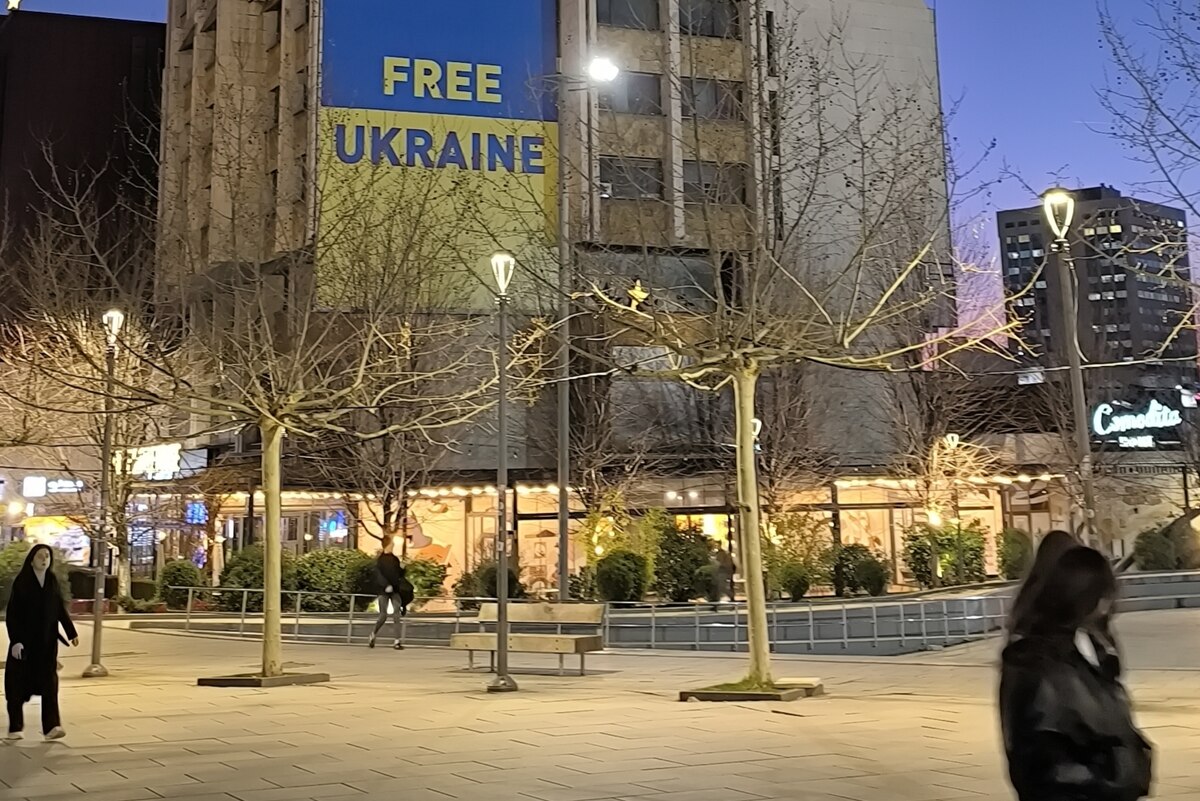
Xharra says that in Kosovo people feel strong solidarity with the invaded Ukraine, for they are reminded of their own history. While Belgrade claims Kosovo is Serbia, Moscow says that Ukraine is Russia.
There are parallels in Western reactions as well: some Western leftists sided with the Serbs while they ignored the Bosnian genocide and denigrated the Kosovars’ resistance as nationalism.
A reversal of perpetrator and victim, as is heard today in the case of Ukraine — ideological blindness under the torn, yet still present NATO shield.