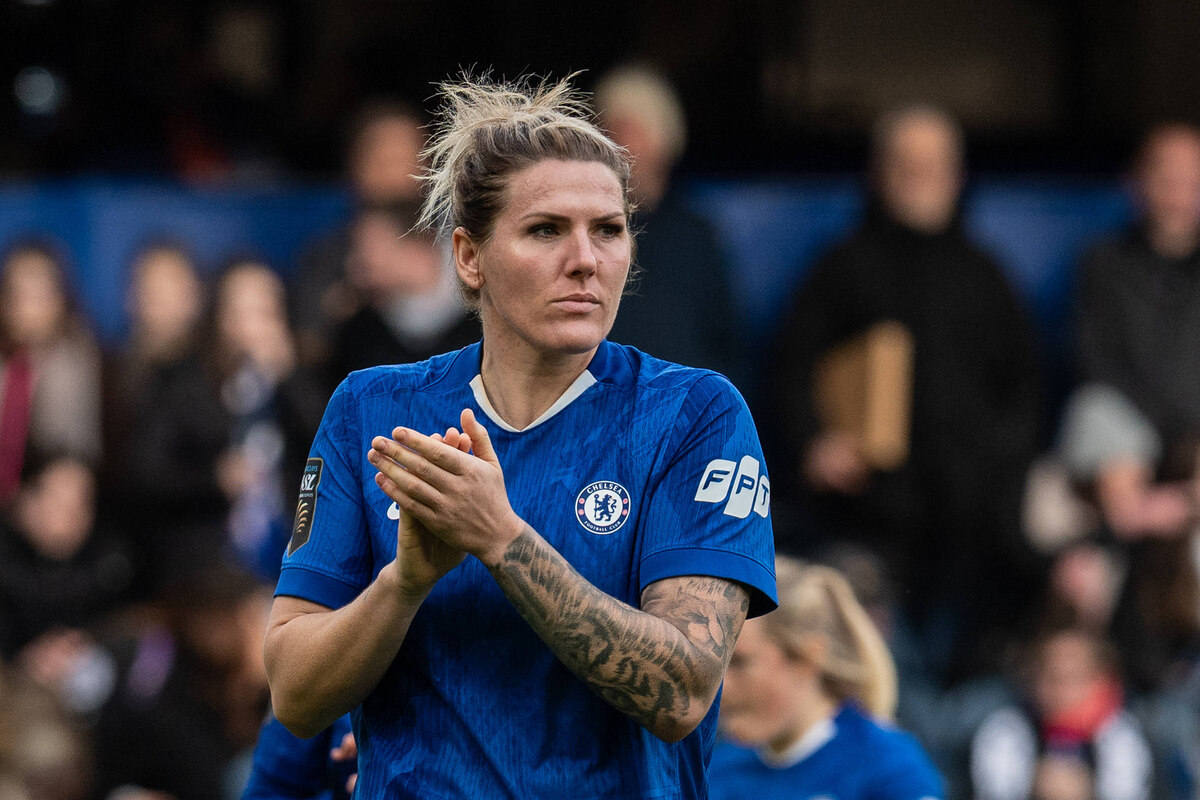
Millie Bright, the central defender from Chesterfield, belongs to that generation of players who have lived through and helped shape the recent rise of women’s football—and have paid a high price for it: she has repeatedly been plagued by injuries and has also been the target of hate-filled comments.
When Bright signed her first contract with the Doncaster Belles in 2009, one of the eight founding clubs that would later become part of the Women’s Super League (WSL), she played on smaller stages. The big arenas came later, and even with the move to Chelsea in 2014 not immediately.
The path to the string of success with Chelsea FC’s 20 titles, a World Cup Final appearance, and the 2022 European Championship title with England, was initially not shaped by professional conditions. Bright recalls in club media: “We used to complete entire training sessions in a tiny shed.” In the rain, we went outside with the weight sled. It wasn’t until the 2020s that there was a dedicated fitness studio for the women. “I’m proud that we achieved nothing with nothing. That keeps us humble.”
She has won a lot: eight league titles, six FA Cups, four League Cups, and twice the domestic trebles. With 314 competitive appearances she is Chelsea’s record appearance maker and, since 2023, captain. At the same time she is the WSL’s record appearance holder with 216 league appearances and, of course, has the most WSL titles.
For England Bright has lined up 88 times, crowned by the home Euros title in 2022. National coach Wiegman trusted in her, who had also grown with the increasing professionalism. Thus the player who in youth ran around wildly and too often tackled has long since become a strategist. Her heading strength and her build-up play also prepared her for Wiegman’s plan to occasionally send her forward to win the ball and secure it.
I hope that we look after the game, and do not allow it to become a toxic place.
Millie Bright
No-Nonsense Defender
At the 2023 World Cup, in Leah Williamson’s absence due to injury, she captained the Lionesses and guided them to the final. At heart Bright has always remained a “no-nonsense defender,” as the English say. Even in her public appearances.
She said she had played injured for six years, telling the BBC. Because of an ankle injury, the 32-year-old had not been on the pitch since February, and in the summer she again faced setbacks while preparing: too much. She had declined to join the Lionesses ahead of Euro 2025, saying she could not give everything mentally or physically. This drew the abuse of football nationalists.
“All the abuse was too much for me. Last year I lost myself, and it took a long time to rebuild,” Bright said. The experience that with heightened attention these darker sides were encroaching more into women’s football has recently become more common among players; for example, her former teammate Jess Carter faced racist abuse. “I hope we look after the game, not let it become a toxic place,” Bright wishes.
For now she remains with Chelsea as club ambassador and foundation trustee. And she wants to relish her newly found freedom: “In life you have to make decisions. In football we’re always confronted with answers: where to be, what to eat, and when to come to training. I have reached a point where I am ready to take my life into my own hands.”