Few countries have as complex a relationship with nuclear energy as South Korea: Economically, the technology plays an enormously important role. Yet among the population it is considered controversial.
Although the country lies on the Han River just a one-and-a-half-hour flight from Japan’s Fukushima, the reactor accident there fifteen years ago did not lead to a lasting political upheaval. Moreover, in public opinion polls Koreans consistently stand out for a practically unique trait: many who oppose nuclear energy also support their own nuclear bomb for military deterrence. In short: it is complicated.
In fact, South Korea pursues a chaotic zigzag course in its nuclear policy. When the left-leaning Moon Jae-in came to power almost a decade ago, he promised a long-term, gradual exit from nuclear energy. “Until now, our energy policy has focused mainly on low prices and efficiency, while public safety was secondary. This must change,” Moon said in 2017 at the closing ceremony of the country’s then oldest nuclear reactor. His words were the herald of a veritable revolution.
What followed was only a creeping “exit” that was to be carried out gradually over four decades. Yet the measure was celebrated by civil society. NGOs like Greenpeace argued that the mighty nuclear lobby wielded enormous influence over government officials and the media. Moon seemed to oppose this as the country’s first president to try.
On April 26, 1986, the catastrophic accident occurred at Chernobyl, in what was then the Ukrainian Soviet Socialist Republic. A radioactive cloud contaminated large parts of Europe. Forty years later, looks back and ahead in a special focus. generally uses the local spelling for Ukrainian places rather than the Russian one — including for Chernobyl.
Two New Nuclear Reactors in South Korea
However, when the conservative Yoon Suk Yeol’s political pendulum swung to the right again, the phase-out story was history. After taking office, Yoon made a radical U-turn: the former prosecutor promised a comprehensive expansion of nuclear energy, even speaking of a “nuclear renaissance.” The move was justified by the economic potential that nuclear energy holds for South Korea: by building reactors abroad, the aim was to revive the economy strained since the coronavirus pandemic.
In South Korea, alongside the 26 active nuclear reactors, two more are being built
By now Yoon has long been imprisoned for a failed coup, and with Lee Jae Myung another left-leaning president leads the government. Even if Lee has promised to expand renewable energy, there will still be no exit from nuclear power – quite the opposite. In South Korea, in addition to the 26 active reactors, two more are being built.
Officials always point to the increased electricity needs of the economy. After all, the economy relies heavily on the energy-intensive production of semiconductors. Nuclear energy is accepted as a necessary evil to reduce dependence on Gulf states while not straining the CO2 balance. The question of a final storage for nuclear waste is swept under the rug.
The facts reveal the immense importance of nuclear energy for South Korea: the country is exceedingly resource-poor and generates 30 percent of its electricity from nuclear power plants. In gigawatts, South Korea ranks fifth in the world for nuclear energy production, practically on par with Russia. Moreover, South Korea is also one of the leading exporters of nuclear reactors abroad — especially in the Gulf region, where South Korean firms have secured enormous infrastructure projects.
Boycotts after the Fukushima Disaster
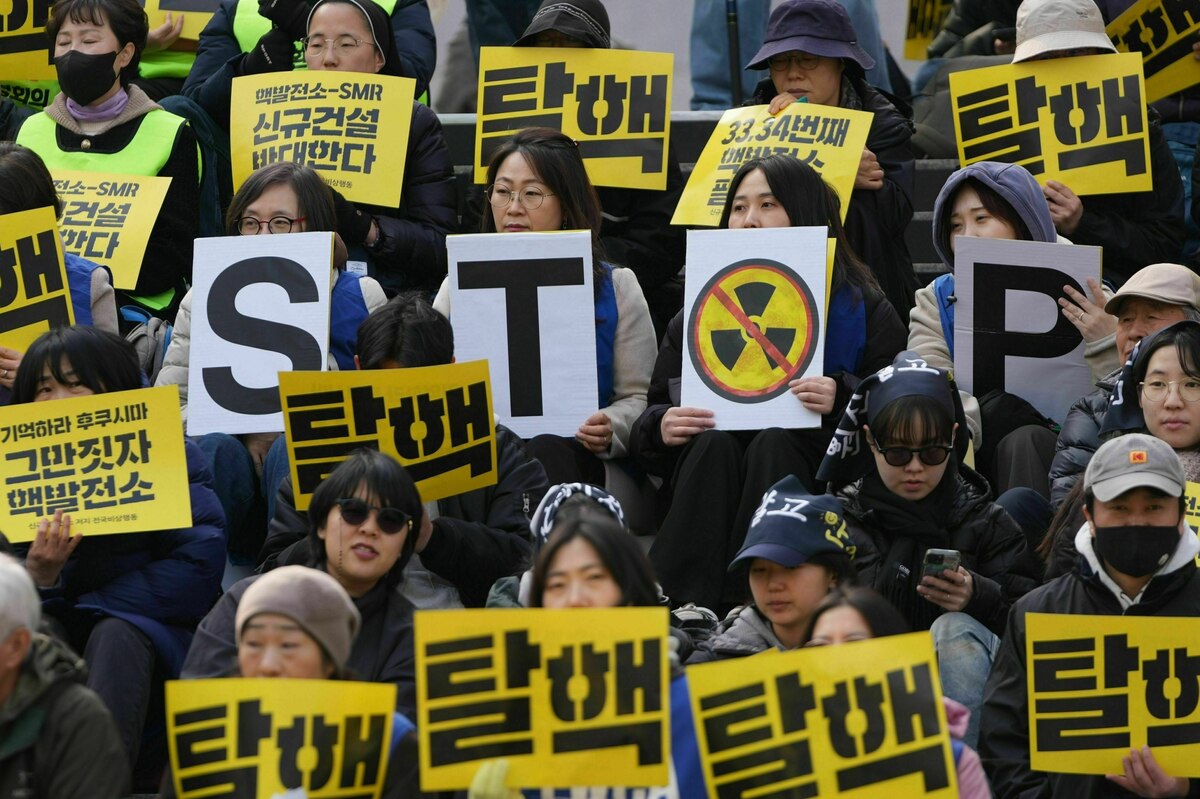
Within the environmental movement, this is far from welcomed. Already in 1986, when a reactor block exploded at Chernobyl, it sparked sporadic protests in distant South Korea. But the then military government paid little heed to civil society concerns. It was not until the following year that the country held its first free elections.
The far more consequential disaster occurred in 2011 at the neighboring Fukushima. And the media response was strong: for years, many South Koreans boycotted fish products from Japan, even as health experts had long said the concerns were exaggerated. And when Japan began in 2023 to discharge treated water diluted with seawater from the destroyed reactor into the Pacific, protests in South Korea were immense. Yet this did not lead to a political rethink at home. Because the costs of a sustainable nuclear exit always seemed too high.