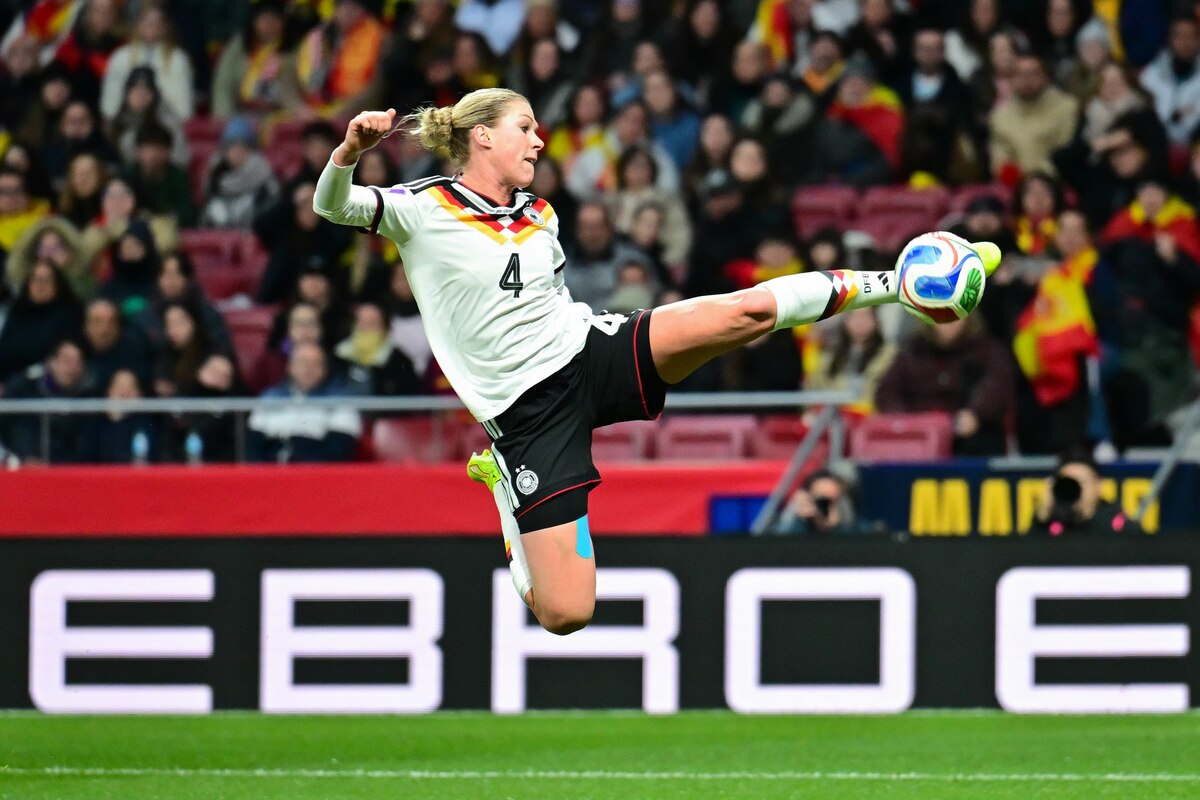
: The DFB women’s national team’s World Cup qualifying campaign starts with a home game against Slovenia (Tuesday 17:45 / ARD). In Dresden, more than 17,000 tickets have already been sold; the crowd numbers in Düsseldorf and Kaiserslautern have also been impressive recently.
Rebecca Knaak: Exactly what we always wanted to achieve. It motivates us even more. In every home game it makes a huge difference when so many people are behind us.
In Interview: Rebecca Knaak
ist deutsche Fußballspielerin. Im Alter von 28 Jahren kam sie zu ihrem Debüt in der A-Nationalmannschaft. Seit 2025 spielt sie beim britischen Erstligisten Manchester City.
: The last international match in Dresden was a 2-1 victory against France in October 2022. In central defense, Sjoeke Nüsken played—and no one had Rebecca Knaak on the radar. Why did it take so long for your debut?
Knaak: I actually had a seamless transition into the A-national team when I was in Silvia Neid’s squad in 2015. But looking back, I didn’t take my chance as well back then. As a young player I was not mentally, physically and tactically ready for that big step.
: As a defender, you must keep an eye on Lara Prašnikar, who in the Bundesliga until last summer played for Eintracht Frankfurt. What distinguishes her?
Knaak: A class-player. Her national team stands for a lot of fighting spirit. That will be quite a bit of work.
: The second World Cup qualifying match against Norway will then be played on artificial turf. How do you view this challenge?
Knaak: I’m a bit more used to that from Sweden. It’s not ideal, but in the end we’ll just talk about it briefly and then it will be accepted. We simply have to accept these circumstances.
: You moved from SC Freiburg to FC Rosengård in January 2022.
Knaak: It was exactly the right move for me. Out of a structured environment. I could leave behind the familiar guidelines, including the tactical instructions. I had no stamp anymore, and I was received there as a player like a blank sheet of paper. I could learn a lot there from many experienced national players football-wise, but also personally. This input awakened strengths in me that I wasn’t even aware of. For me, Sweden was a stroke of luck.
: Is the country further along in terms of acceptance of women’s football?
Knaak: Partially there are similar challenges as with us, because currently Sweden’s league can hardly keep its best players. In general, the population may be somewhat more positive, but the societal and political challenges are almost the same as here.
: You moved to Manchester City in 2025 and play in the promised land of women’s football. Your club has just built a training center for 15 million euros.
Knaak: We will move into this complex right after the international match window. We will now have our own meeting, physiotherapy, strength and dining rooms – and our own pitches. Our conditions were already top, and now they will be optimized again. The status of women’s football in our club is extremely high.
: Do you feel that women’s football is riding the wave of the big men’s clubs or is it now valued as its own brand?
Knaak: Initially the women were pulled along by the brand, but now we are at a point where we are autonomous. We have dedicated managers so that Manchester City Women are perceived as their own brand. Arsenal is the best example: Almost 40,000 attend every game because their ladies have become their own brand.
: The attendance average in the Women’s Super League is just under 7,000. In front of how many people do you usually play on a daily basis?
Knaak: We always have at least 5,000 spectators at the Academy Stadium. The atmosphere is really good. In the men’s stadium, we play three or four matches.
: Manchester City is the table leader in England and you are a regular starter.
Knaak: After a coaching change, we really worked our way into the team. I enjoy a high standing with the coaching staff. I had already thought: Will I get enough playing time given the competition? But we have found our place in the back four.
: In Germany, the 14 clubs decided to push the professionalization of the women’s Bundesliga forward without the DFB.
Knaak: We national players also want the league here to unleash its maximum potential. Conflicts mean that everyone involved wants something. Clubs, the association, and players want to advance the league. In the long term, hopefully this will lead to something positive.