In the popular Poblenou neighborhood in Barcelona, Cavina Vinoteca has earned an enviable reputation for its wine selection and its sophisticated atmosphere. It is the visible face of a series of gastronomic businesses led by the Oleinikova family, with the matriarch, María Oleinikova, born in Russia and naturalized as Spanish, at the helm. Alongside her children, she also runs Complexe Sancu, a company dedicated to exporting Spanish beverages — wine, beer, cider, and liqueurs — to the Russian market, which has been operating in Spain for years and was fully integrated into our society, according to the National Police.
However, behind the shine of wine glasses and business success lies a complex and dark judicial investigation. In it, a series of import documents and investigative reporting carried out by the Organized Crime and Corruption Reporting Project (OCCRP) reveal that the Oleinikova family’s activities allegedly extend far beyond beverages, penetrating the sensitive market of industrial chemical products, with potential violations of European Union (EU) sanctions imposed after Russia’s large-scale invasion of Ukraine in 2022. It is worth noting that the investigative entity originates from the United States.
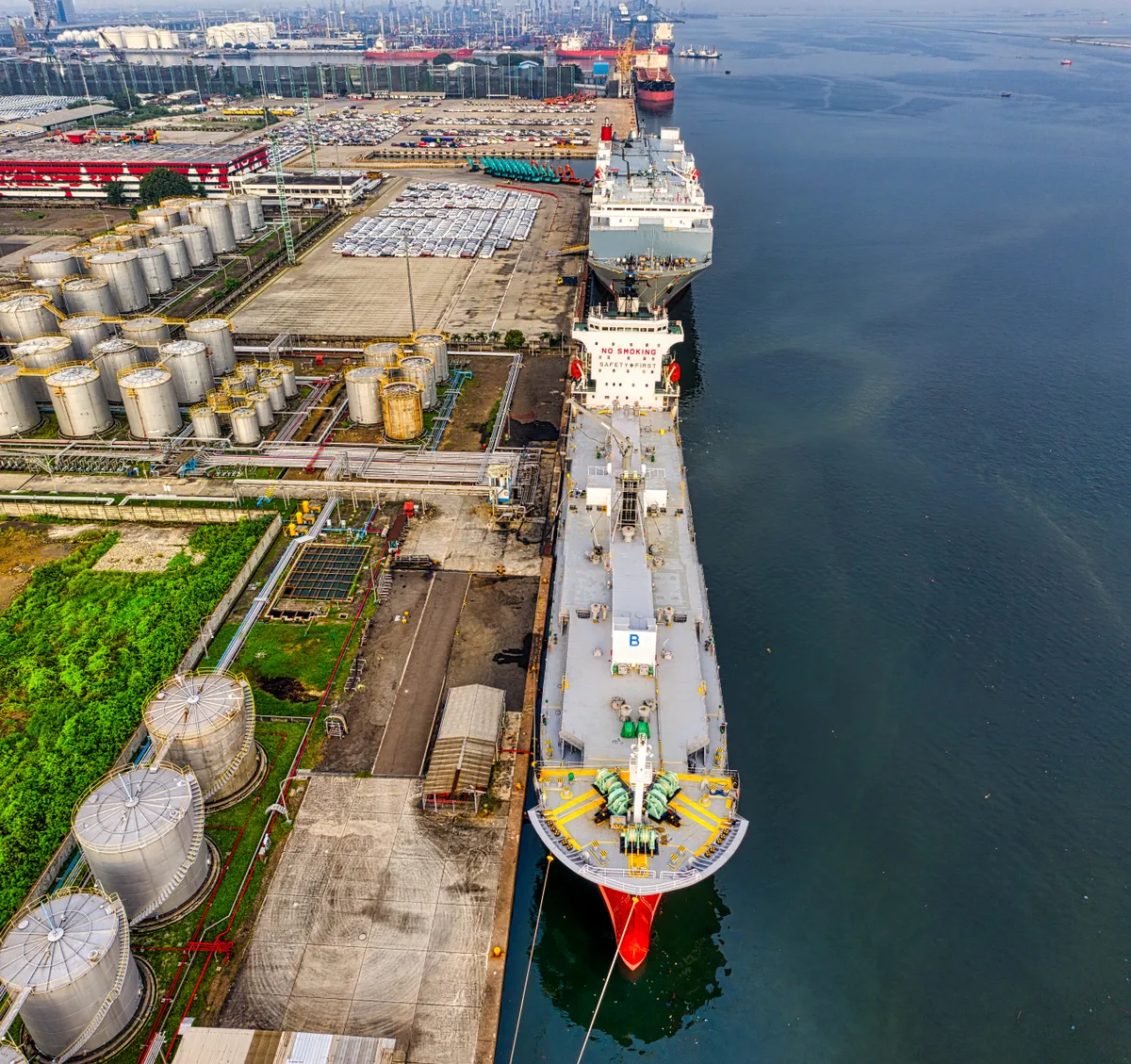
Last year, María Oleinikova and her two children, Irina and Vyacheslav, found themselves at the center of a high-profile police raid carried out by Spanish authorities, dubbed “Operación Probirka” (or “Operation Test Tube”). The operation culminated with the seizure of 13,000 kilograms of chemical products at the Port of Barcelona.
The Spanish Ministry of the Interior confirmed in a statement that the “Operation Test Tube” was part of a broader investigation into the illegal supply of chemical substances to Russia. In total, the investigation identified nine suspects, including the three Oleinikova family members and executives of the prominent Spanish chemical company Scharlab SL, based in Barcelona. Among those initially detained was Werner Scharlau, the German citizen residing in Spain and the majority owner of Scharlab.
Although the government has been reserved with details, a Spanish police source involved in the case, who spoke on condition of anonymity due to the sensitive nature of the investigation, indicated that authorities suspect that Oleinikova acted as a key “intermediary”, orchestrating and facilitating the sanctioned shipments.
Despite the arrests, the Audiencia Nacional of Spain, the court specialized in serious crimes, confirmed that the nine suspects remain on provisional release while the investigation into “smuggling of prohibited substances” continues. To date, formal charges have not yet been filed against any of those investigated. Oleinikova, citing the ongoing investigation, has declined to comment.
The true gravity of the case emerges when crossing the data of the Spanish companies investigated with the import records and Russian transactions. The American journalists allegedly discovered that María Oleinikova is not merely a gastronomy entrepreneur in Spain; she is also the majority shareholder of a Russian chemical company, Catrosa Reactiv, acquired by her family in 2008.
Catrosa Reactiv, which appears on its website as a key supplier for Russian laboratories and industry, allegedly has received at least 36 shipments of prohibited chemicals from Spain between 2022 and 2024. Surprisingly, one of these shipments came directly from Complexe Sancu, the Oleinikova family’s own wine and beer exporting company. However, the vast majority of the sanctioned shipments—32 consignments—were carried out by the other company under investigation, Scharlab SL. These 32 shipments contained 14 chemicals with a value of about $15,000, all subject to EU export prohibitions.
The final destination of these chemicals raised alarms of several international police forces, in addition to our own. And the leaked transaction data obtained by the journalists shows that since 2022, Catrosa Reactiv’s clientele includes at least six sanctioned entities with direct links to the defense, weapons, and Russian military sector.
The most notorious client is the State Scientific Research Institute of Organic Chemistry and Technology (GosNIIOKhT), an entity explicitly sanctioned by the EU and the US for its crucial role in the development of chemical weapons, including the devastating nerve agent Novichok.
Additionally, Catrosa Reactiv has received payments from other high-sensitivity entities:
- The Pan-Russian Institute of Scientific Research in Experimental Physics, developer of the first Soviet atomic bomb and operator of Russia’s supercomputers.
- The Institute of Scientific Research in Applied Acoustics, sanctioned by the US for its work in developing military products and the procurement of precursors for chemical weapons.
- The explosive manufacturer SKTB Technolog, a key contractor of the Russian Ministry of Defense.
- The 18th Central Research Institute (Military Unit 11135), a branch of the Russian military intelligence service, the GRU.
Although this journalistic investigation did not identify any direct manufacturer of chemical weapons in Catrosa Reactiv’s import data, Professor Miguel Ángel Sierra, a professor of organic chemistry and former member of the Organisation for the Prohibition of Chemical Weapons, noted that the imported substances “are sanctioned for their dual-use potential.”
“These have been banned by the European Union for being industrial products,” Sierra explained. “There are many processes that cannot be carried out, such as the preparation of explosives, the production of pharmaceutical products, and the making of many other products, without some of these substances,” the cited expert emphasized.
The ease with which these prohibited substances, valued in thousands of dollars, managed to exit the EU points to a structural flaw in the customs control mechanisms of European countries. In this regard, experts agree that “the EU systems are not designed to cope with the breadth of sanctions on chemical exports.”
Elina Ribakova, a senior fellow at the Peterson Institute for International Economics, warned that product classification through the Harmonized System codes (HS codes) presents a critical vulnerability. These codes are broad identifiers that group a wide range of products, allowing a prohibited substance to be exported under a code that does not explicitly identify it as sanctioned.
“The question is whether the product is correctly classified under its proper HS code and whether it is actually being controlled,” Ribakova said, adding that it is “very difficult to identify a product” when codes group it. “Europeans do not have the infrastructure to verify more comprehensively something that is not a nuclear weapon or highly specialized,” she concluded, noting that this limitation facilitates smuggling.
In the case of Operation Test Tube, investigators have identified sophisticated tactics used by exporters to evade controls:
- Batch Blending: Prohibited chemicals were hidden in larger shipments of legal substances.
- False Destinations: Destinations such as Armenia and Kyrgyzstan were indicated on customs documents to mask the final destination: Russia.
An investigator on the case revealed that the evidence suggests the shipments did not pass through those intermediary countries and that the recipient companies identified could be mere fronts. Instead, the shipments could have been directed directly to Russia by land through third countries such as Poland and Belarus.
Apparently, Catrosa Reactiv’s import records validate these diversion tactics. In 2023, the Russian company received a shipment of the sanctioned solvent N-methyl-2-pyrrolidone (NMP), the same chemical seized at the Port of Barcelona. Although the shipment originated in Spain, it was routed through a Kyrgyz company, NK Muras LLC.
The supply chain does not end there. The vendor acting on behalf of NK Muras was Vlate Logistik LLC, a Belarusian transport and storage company, sanctioned by the EU in December 2024 for its support of the regime of Alexander Lukashenko, an ally of Moscow.
Even Complexe Sancu, the Oleinikova family’s beverage company, appears in the records with at least one shipment of NMP sent to NK Muras in 2024. Separate transaction data show that Catrosa Reactiv paid more than $240,000 to NK Muras in 2023 for shipments of unspecified pharmaceutical ingredients.
While the Oleinikova family’s businesses continue to operate in Barcelona, the Spanish authorities and the Audiencia Nacional face a complex challenge: dismantling a smuggling network that, allegedly, has used European commercial infrastructure to supply key Russian entities with substances that could enhance their military and industrial capacity, evading international sanctions at a critical moment in geopolitics. The “Operation Test Tube” serves as a stark reminder of how the war in Ukraine is fought also in the discreet world of logistics, customs, and, paradoxically, among the elegant wine bars of Barcelona, yet still without those responsible for it and the suspects in the streets.