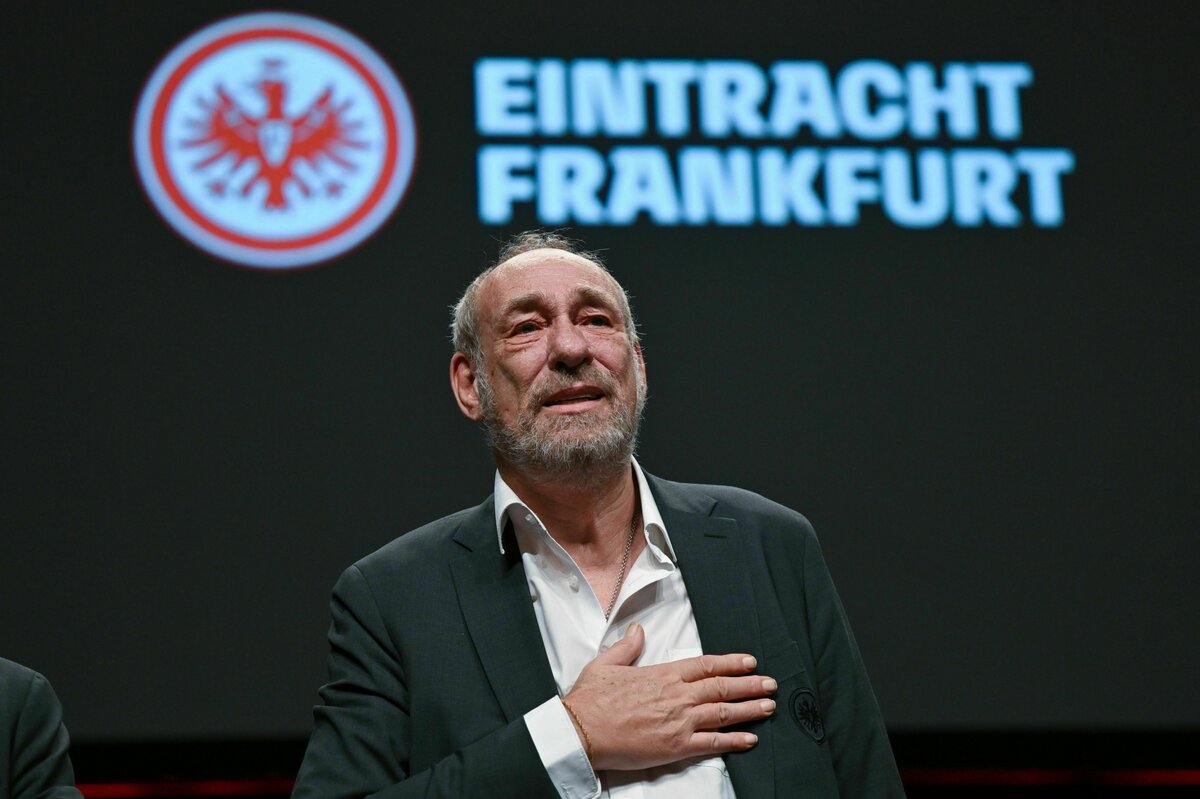
B Among all the ugly things happening in the world, one must be careful not to completely miss the good things. For one of these good things, Peter Fischer has taken care, former president of Eintracht Frankfurt, who in a television interview spoke the following correct words about AfD voters: “Storm their doors and gates, give them slaps, vomit in their faces. I don’t give a damn. Make noise, and finally show yourselves. They must become aware — this is not just a cross. With that you are a National Socialist, nothing else.” That was in February of this year.
Not surprisingly, from that circle a few who felt addressed crawled out of their holes and filed complaints; 65 complaints were submitted to the public prosecutor. The Cologne public prosecutor’s office has now stopped the investigations. It is claimed that Fischer’s words do not constitute a call to commit a crime, but rather an emotional fundamental critique of the AfD, and within this framework it is allowed. An insult is also not detectable, after all the term “National Socialist” is an statement that is even protected by the constitutional protection agency.
In light of this decision, a few crocodile tears flowed from those very Nazis, which is at least irrelevant, if not perhaps pleasing. Aside from these ideologically motivated attempts to pose as a threatened opposition that fears violence — Peter Fischer is 68 years old, by the way — there are, of course, again legions of the ignorant who in their backwardness believe they must decree that football must remain apolitical at all costs.
Football was never apolitical and it never will be. That is obvious: a mass phenomenon like football is always entangled with society and politics. A look into the history of goal celebrations would help those who demand the depoliticization of football to realize what nonsense they utter.
Famous Goal Celebration
In the 1930s Austria possessed one of the strongest national teams in the world, and Vienna was one — if not the — capital of European football. In particular, Vienna’s Austria practiced a distinctive style of play, characterized by constant positional changes, a tactical understanding of space, and an uncompromising will to have the ball, which can be seen as a precursor to the later Dutch total football. The centerpiece of this team was Matthias Sindelar, whom they in cafés nicknamed the “Paper” because of his slenderness.
Austria — at the time a strongly Jewish-influenced club — was effectively dissolved after the Anschluss of Austria, and the Austrian national team had to play one last match against the Reich before it would be absorbed into a Großdeutsche Mannschaft. The order was that Austria was not allowed to score a goal.
However, the Austrians played the Germans off the pitch, and after Sindelar repeatedly turned away from the open goal, he finally scored the 1-0; he then stood in front of the honor tribune filled with Nazis and performed a small dance. This was one of the most famous goal celebrations in German football history. In the end, Austria won 2-0.
Sindelar, who was not a political activist, later declined Sepp Herberger’s calls to join the Großdeutsche Mannschaft, but benefited from the Anschluss: He took over a café from its Jewish former owner. He died in 1939 under circumstances that were never fully clarified, in his apartment, from carbon monoxide poisoning, ten months after Austria’s incorporation into the National Socialist German Reich.